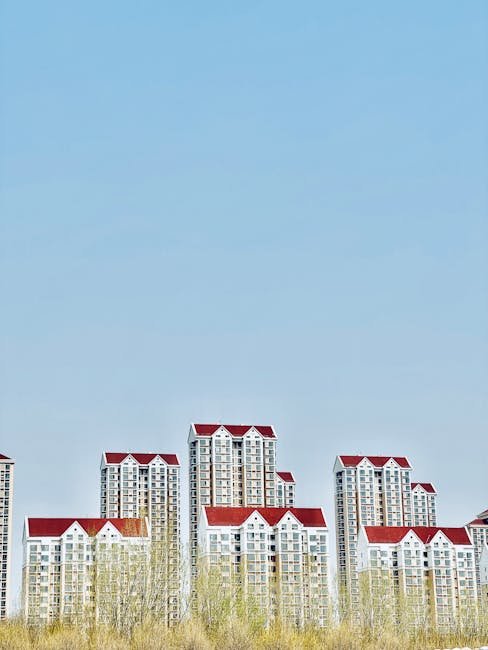
Mid-rise apartments (多层住宅, duo ceng zhu zhai) — typically defined as buildings of four to eight stories without elevators — occupy a special place in China's residential landscape. While high-rise towers dominate the skylines of major cities, mid-rise buildings form the fabric of countless neighborhoods in smaller cities, older urban districts, and suburban communities. This housing type offers a distinctive set of spatial and social qualities that many residents find preferable to either high-rise towers or low-density sprawl.
Historical Context
Mid-rise apartments were the dominant form of urban housing in China from the 1950s through the 1980s. During the socialist era, state-owned enterprises and government institutions built apartment buildings for their workers, typically in the four-to-six-story range. These buildings were constructed using standardized designs and prefabricated concrete panels, creating the uniform residential blocks that still characterize many Chinese urban neighborhoods. The walk-up apartment building became the quintessential housing type of China's socialist urbanism.
After the economic reforms, mid-rise construction continued but was gradually supplanted by high-rise towers as land values increased and construction technology advanced. However, mid-rise apartments remain a significant portion of China's housing stock, and in many older urban neighborhoods, they continue to house millions of families. In recent years, there has been a renewed interest in mid-rise design among architects and urban planners who recognize the human-scale qualities that this housing type can provide.
"The mid-rise apartment building, when well-designed, achieves a rare balance between density and livability. It is tall enough to use land efficiently but low enough to maintain a human connection to the street. The walk-up access, often criticized as inconvenient, actually creates incidental social encounters that build community in ways that elevator buildings cannot."
Design and Living Experience
Chinese mid-rise apartments typically range from 50 to 150 square meters, with layouts that have evolved significantly over the decades. Older buildings from the socialist era typically have smaller rooms, lower ceilings, and simpler finishes, reflecting the standards of their time. Newer mid-rise buildings offer larger apartments with more contemporary layouts, better insulation, and higher-quality materials. The walk-up access means that upper-floor apartments are less accessible but often offer better light and views, and in some markets, they command lower prices than ground-floor units.
The spatial qualities of mid-rise living differ notably from high-rise apartments. The lower building height means that residents maintain a visual connection to the street and neighborhood, rather than being isolated in the sky. The walk-up access creates incidental encounters with neighbors on stair landings and at building entrances, fostering a sense of community that is often lacking in high-rise elevator buildings. The lower density also means less competition for shared resources such as parking, green space, and community facilities.
Challenges and Renovation
Many of China's existing mid-rise apartments are aging and in need of renovation. The prefabricated concrete buildings of the 1950s-1980s face challenges with insulation, plumbing, electrical systems, and seismic safety. In response, the Chinese government has launched ambitious programs to retrofit and upgrade existing mid-rise housing stock, adding insulation, replacing windows, upgrading utilities, and in some cases, adding elevators to walk-up buildings to improve accessibility for elderly residents.
The retrofit of mid-rise apartments with elevators is a particularly significant trend in Chinese cities. As China's population ages, the walk-up building becomes increasingly problematic for elderly residents who cannot easily climb stairs. Government programs now subsidize elevator installation in existing mid-rise buildings, transforming them into de facto high-rises with improved accessibility. This pragmatic adaptation extends the useful life of China's mid-rise housing stock while improving quality of life for millions of residents.
For homebuyers and renters in Chinese cities, mid-rise apartments offer a compelling combination of affordability, community character, and urban location. While they may lack the prestige amenities of luxury high-rise developments, they provide a quality of urban living that is increasingly valued by those who seek authentic neighborhood experiences and human-scale environments. As Chinese cities evolve, the mid-rise apartment building is likely to be rediscovered as a valuable housing type that contributes to urban diversity and livability.
The mid-rise typology occupies a unique position in global urban history, and China's experience with it offers lessons for other rapidly urbanizing countries. European cities such as Paris, Barcelona, and Berlin demonstrate that mid-rise apartment buildings — typically five to seven stories — can create some of the world's most beloved urban neighborhoods, combining high residential density with human-scaled streetscapes and strong neighborhood identity. Chinese planners and architects increasingly look to these European precedents as they seek alternatives to the tower-in-the-park model that has dominated Chinese urbanization. Recent master plans for new urban districts in cities including Nanjing, Suzhou, and Qingdao explicitly mandate mid-rise street-wall building typologies inspired by European models, representing a significant shift in Chinese urban design philosophy.
The sustainability case for mid-rise housing is compelling. Mid-rise buildings can achieve net-zero energy performance more readily than high-rises, as their lower height reduces wind loads and stack effects that drive heat loss, while their larger roof-to-floor-area ratio makes rooftop solar more viable per dwelling unit. They can be constructed with timber or hybrid timber-concrete structures, dramatically reducing embodied carbon compared to all-concrete high-rises. Their lower construction cost and simpler engineering requirements make them suitable for a wider range of developers, potentially democratizing access to quality urban housing. As China confronts the dual challenges of carbon neutrality and housing affordability, the humble mid-rise apartment building may prove to be one of its most valuable architectural assets.
The construction economics of mid-rise housing reinforce its strategic importance for Chinese urbanization. Mid-rise buildings generally fall below the height thresholds that trigger the most demanding and expensive structural requirements of Chinese building codes — including performance-based seismic design, specialized firefighting access, and mechanical smoke extraction systems — making them substantially less expensive to construct per square meter than high-rises. A 2024 comparative study by the China Academy of Building Research found that mid-rise residential buildings (6-8 stories) cost approximately 22 percent less per square meter to construct than high-rise buildings (25-30 stories) of equivalent quality, while achieving similar net residential densities when site coverage and building footprint efficiency are accounted for. These economic advantages, combined with the environmental and social benefits of mid-rise living, make a compelling case for revising Chinese urban planning norms that have historically privileged high-rise development over mid-rise alternatives.
The residential character of mid-rise neighborhoods in Chinese cities offers a distinctive quality of urban life that differs markedly from both the anonymity of high-rise districts and the isolation of villa suburbs. In older mid-rise neighborhoods, street-level retail establishes a vibrant public realm — small grocery stores, repair shops, noodle houses, and tea shops occupy ground-floor spaces or purpose-built annexes, creating the kind of pedestrian-oriented urbanism that contemporary planning theory celebrates. The walkability of mid-rise neighborhoods is significantly higher than that of gated villa compounds or superblock high-rise estates, not because of any deliberate planning but because the building typology itself supports fine-grained street networks and diverse ground-floor uses. Residents of well-established mid-rise neighborhoods in cities such as Chengdu, Hangzhou, and Nanjing consistently report higher levels of neighborhood satisfaction and place attachment than residents of newer high-rise districts, suggesting that the mid-rise typology, when combined with appropriate urban grain and mixed-use development, creates urban environments that people genuinely value and identify with.
Adaptive Reuse and Urban Renewal
The adaptive reuse of existing mid-rise buildings represents a growing trend in Chinese urban renewal, particularly in older city districts where mid-rise apartment blocks form the predominant building stock. Rather than demolishing aging buildings, cities are increasingly investing in comprehensive retrofits that extend building life while improving performance. These retrofits typically include structural reinforcement for seismic safety, replacement of single-glazed windows with double or triple glazing, addition of external insulation, and upgrade of plumbing and electrical systems to current standards.
The social dimension of mid-rise neighborhood renewal deserves particular attention. Unlike the tabula rasa approach of high-rise redevelopment, which displaces existing communities and erodes established social networks, mid-rise retrofitting allows residents to remain in their homes and neighborhoods while benefiting from improved living conditions. Community engagement in the retrofit process has been shown to significantly improve satisfaction outcomes and preserve the social fabric that makes older urban neighborhoods vibrant and resilient.
The economic case for mid-rise retention and retrofit is increasingly compelling when the full costs of redevelopment are accounted for. Embodied carbon represents a significant environmental cost that is avoided when existing buildings are retrofitted rather than replaced. For a typical six-story mid-rise apartment building, the embodied carbon savings of retrofit over replacement are equivalent to 15-20 years of operational carbon emissions. These calculations, combined with the lower upfront capital costs of retrofit and the preservation of affordable housing stock, create a powerful argument for prioritizing mid-rise renewal over demolition and redevelopment.
The future of mid-rise housing in Chinese cities will be shaped by the interplay of demographic trends, environmental imperatives, and evolving urban design theory. As China's population ages and household sizes shrink, the flexibility of mid-rise apartments to accommodate a variety of household types positions the typology well for changing demographic conditions. The inherent energy efficiency of mid-rise building forms, combined with the feasibility of deep-energy retrofits, aligns with China's carbon neutrality goals. The growing recognition among urban planners that mid-rise neighborhoods produce superior social and environmental outcomes to both high-rise and low-density alternatives suggests that this often-overlooked housing typology will play an increasingly important role in shaping Chinese cities of the future.
Community dynamics in mid-rise neighborhoods represent a distinctive form of urban social organization that differs markedly from both high-rise estates and villa compounds. The walk-up building form creates casual encounters on staircases and landings that foster neighborly recognition and mutual support. Children play in the semi-private spaces between buildings rather than in distant playgrounds, while elderly residents sit at building entrances and maintain informal surveillance of the neighborhood. These social patterns contribute to a sense of safety and belonging that mid-rise neighborhoods naturally generate.
Neighborhood Character and Street Life
The distinctive character of mid-rise neighborhoods in Chinese cities emerges from the interaction between building form and street-level activity. Unlike the isolated towers of high-rise estates, mid-rise buildings typically align with street grids, creating continuous pedestrian-oriented streetscapes that encourage walking and social interaction. Ground-floor retail spaces in older mid-rise neighborhoods host small grocery stores, traditional medicine shops, noodle houses, and tea shops, generating a vibrant public realm that high-rise districts rarely achieve. The moderate density of these neighborhoods supports public transportation routes and local services that make daily life convenient without requiring car ownership.
Sustainability and Environmental Performance
Mid-rise buildings offer significant environmental advantages over both high-rise towers and suburban villas. Their lower height reduces wind loads and stack-effect heat loss, while the larger roof-to-floor-area ratio makes rooftop solar panels more viable per household. Mid-rise structures can be built with timber or hybrid timber-concrete systems, dramatically reducing embodied carbon compared to concrete high-rises. Their simpler engineering requirements mean less steel and cement per square meter. When sited to maximize passive solar gain and natural ventilation, mid-rise buildings can approach net-zero energy performance. These advantages make the mid-rise typology increasingly attractive for meeting China's carbon neutrality commitments.
Future Outlook and Urban Policy
Chinese urban policy is gradually shifting toward greater recognition of mid-rise housing's value. New urban district master plans in cities like Nanjing, Suzhou, and Qingdao now mandate mid-rise street-wall typologies inspired by successful European models. The economic case is strong — mid-rise buildings cost roughly 22 percent less per square meter to construct than equivalent-quality high-rises, while achieving similar net densities. As China's population ages, the walk-up character of existing mid-rise neighborhoods is being addressed through government-subsidized elevator retrofits that improve accessibility while preserving community fabric. The future of Chinese urbanism may well include a greater role for the mid-rise typology.