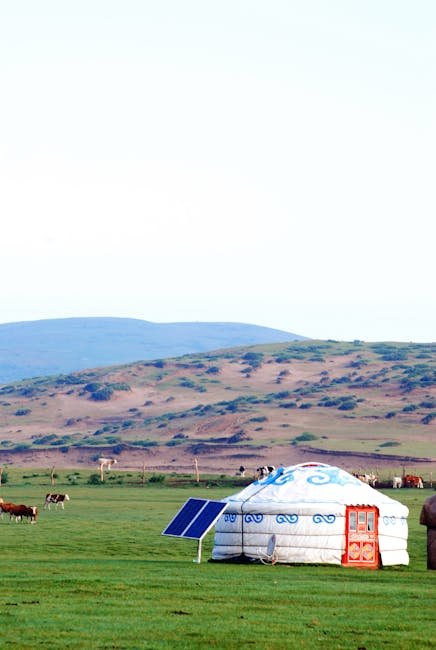
The Mongolian yurt (蒙古包, meng gu bao) — known as ger in Mongolian — is one of the world's most successful vernacular building types. This portable, round dwelling has been the home of Central Asian nomads for over two thousand years, providing shelter that is warm in winter, cool in summer, quick to assemble, and easy to transport. The design of the yurt represents a remarkable engineering achievement — a lightweight structure that withstands extreme weather conditions while maintaining a comfortable interior environment. The Mongolian term ger simply means "home" or "household," reflecting the yurt's central role in nomadic identity: it is not merely a shelter but the locus of family life, hospitality, and spiritual practice. The Chinese term meng gu bao (蒙古包), by contrast, describes the physical form: meng gu means "Mongolian" and bao means "bag" or "enclosure," emphasizing the tent-like appearance of the felt-covered structure.
Structure and Construction
The yurt consists of four main structural components: the lattice wall (哈那, khana), the roof poles (乌尼, uni), the compression ring (陶脑, tono), and the felt coverings. The lattice wall is made of interwoven wooden slats that can expand and contract, allowing the yurt to be folded into a compact bundle for transport. The roof poles radiate from the compression ring at the center of the roof to the top of the lattice wall, creating a conical roof structure. The compression ring, typically made of wood or metal, serves as the crowning element and allows light and smoke to escape. The materials for these components derive from the steppe environment itself: willow or birch saplings are harvested for the lattice slats, cut in the spring when the sap is running so the bark can be peeled easily; roof poles are made from longer, straighter branches; and the tono ring requires the largest single piece of wood in the entire structure, often sourced from a carefully selected tree that is split and carved with traditional tools over several days.
The wooden frame is covered with layers of felt made from sheep's wool, which provides exceptional insulation. In winter, two or three layers of felt are used, creating a warm interior even when outside temperatures drop below -30 degrees Celsius. In summer, the felt layers are reduced and the lower edges of the covering can be rolled up to allow cooling breezes to enter. The felt is held in place by ropes made of horsehair or wool, which are tightened around the circumference of the yurt. The process of making felt (эсгий, esgii) is itself a community ritual: sheared wool is spread evenly on a reed mat, moistened with hot water or whey, rolled tightly, and then rolled back and forth by several people for hours until the fibers mat together into a dense, water-resistant fabric. The finished felt is naturally antimicrobial, breathable, and remarkably durable — a well-maintained felt covering can last for decades.
The assembly and disassembly of a traditional ger is a remarkable feat of material culture, achievable by a single family in under two hours. The process always follows a prescribed order: first the door frame is positioned facing south, then the khana lattice walls are expanded and lashed together in a circle. Ropes are tied around the top of the lattice to stabilize the structure before the roof poles are inserted — their lower ends resting on the lattice heads and upper ends socketed into the tono compression ring. Two central posts temporarily support the tono until all roof poles are in place and the structure becomes self-supporting through compression. The felt layers are then draped over the frame in sequence, beginning with the roof and working downward, secured by the outer tension bands. This standardized procedure, transmitted orally across generations, has remained essentially unchanged for over a millennium — a testament to the ger's perfection of form. For transport, the entire structure is collapsed into bundles that can be loaded onto two or three camels or a single truck: the lattice walls fold into bundles about the size of a person, the roof poles tie into sheaves, the tono is carried flat, and the felt is rolled into cylinders. A complete ger packs into a load of roughly three hundred kilograms.
"The Mongolian yurt is a masterpiece of minimalist design. In its structure, every part serves multiple purposes; in its use, every space is optimized for function. The yurt is not just a dwelling but a complete living system, adapted perfectly to the nomadic way of life on the vast Eurasian steppe."
Interior Organization
The interior of a traditional Mongolian yurt is organized according to well-established conventions. The center of the yurt is occupied by the stove, which provides heat for cooking and warmth. The space to the north of the stove (opposite the door) is the most honored position, reserved for the altar with Buddhist images and offerings, and for honored guests. The western side is traditionally the men's side, where tools, saddles, and hunting equipment are stored. The eastern side is the women's side, where food, cooking utensils, and children's belongings are kept. These spatial conventions are not arbitrary but encode the values and social structure of nomadic pastoralist society — the hierarchy between host and guest, the gendered division of labor, the centrality of the hearth fire as a sacred element, and the orientation toward the south as the direction of sunlight and prosperity.
The furnishings of a yurt are designed to be minimal and portable. Low tables and cushions serve as seating and dining surfaces. Storage chests line the walls, holding clothing, bedding, and household goods. Beds are rolled out at night and stored during the day. The floor is covered with felt rugs and animal skins, providing insulation and comfort. Despite its compact size — typically 15 to 30 square meters — the well-organized yurt interior provides comfortable and dignified living space for a family of four to six people. The patterned felt floor coverings, traditionally made using the shyrdak and ala kiyiz techniques, are themselves significant works of decorative art. Shyrdak felts are created by cutting identical patterns from two layers of differently colored felt and swapping the pieces, creating a mosaic of bold geometric designs. Ala kiyiz felts use a wet-layering technique where dyed wool fibers are arranged in abstract patterns on a base felt and then pressed and rolled to bond them into a single fabric. Both techniques produce distinctive textile art that serves as portable decoration and, in the tightly organized interior of the ger, provides visual warmth and color against the white felt walls.
Contemporary Relevance
The Mongolian yurt continues to be used by herders on the steppes of Inner Mongolia and Mongolia, though many now live in permanent houses or use yurts only seasonally. The design has also attracted attention from architects and designers worldwide who are interested in its structural efficiency, portability, and minimal environmental impact. Yurt-inspired structures are used for ecotourism lodges, glamping accommodations, and temporary event spaces around the world. Several architecture firms have developed modern yurt kits that replace traditional felt with high-performance synthetic membranes and the wooden lattice with aluminum or steel, while maintaining the fundamental structural logic of compression ring, radial poles, and tension band. Whether in its traditional form or contemporary reinterpretations, the yurt demonstrates that a dwelling type developed for the Central Asian steppe over two millennia ago remains surprisingly relevant to twenty-first-century concerns about portability, sustainability, and minimal-impact living. In Inner Mongolia, government-subsidized housing programs have encouraged herders to settle in permanent brick houses, but many families maintain a ger in the yard for summer use or to accommodate visiting relatives — a practical acknowledgment that the yurt remains the most comfortable dwelling in the region's extreme continental climate.
The yurt also carries deep cultural significance for Mongolian people. It is not just a dwelling but a symbol of identity, representing the nomadic heritage, family values, and spiritual beliefs of the Mongolian people. The circular form of the yurt represents the cosmos, the compression ring symbolizes the connection between heaven and earth, and the hearth at the center represents the continuity of family and tradition. As Mongolia and Inner Mongolia modernize, the yurt remains a powerful symbol of cultural identity and a living link to the nomadic past. The annual Naadam Festival, which brings together herders from across the steppe, is also a celebration of ger culture, with competitions in traditional assembly speed and craftsmanship.
An elaborate system of behavioral protocols governs life inside the ger, reflecting the dwelling's role as a microcosm of the Mongolian worldview. The threshold must never be stepped on — doing so is believed to bring misfortune to the household. Upon entering, guests move clockwise around the interior, never crossing directly through the center between the two central columns that support the tono. The fire in the central stove must never be extinguished with water; it should be allowed to die naturally or be banked with ash. Offerings to the hearth deity are made before meals. These customs, some rooted in pre-Buddhist shamanic beliefs and others adopted from Tibetan Buddhism, transform the ger from a mere structure into a sanctified space where every action carries spiritual weight. The architecture of the ger and the rituals of its inhabitation form an indivisible whole, each reinforcing the other across generations of nomadic life. The spatial memory encoded in the ger's organization — the honored north, the gendered east and west, the sacred hearth — ensures that each generation inherits not just a building type but a complete framework for social and spiritual life on the steppe.
Thermal Performance and Climate Adaptation
The yurt's thermal performance is extraordinary for a structure that can be assembled in under two hours. The sheep's wool felt covering provides an insulation value (R-value) comparable to modern fiberglass batting of equivalent thickness. In winter, two or three layers of felt create a thermal envelope that retains the heat from the central stove, maintaining interior temperatures above 15 degrees Celsius when exterior temperatures fall below -30 degrees. The circular form minimizes surface area relative to volume, reducing heat loss compared to rectangular structures of equivalent floor area. In summer, the felt coverings are reduced to a single layer, and the lower edge of the wall covering can be rolled up to create a natural cooling draft. The tono opening at the crown provides stack-effect ventilation, drawing warm air upward and out of the structure. The felt itself has hygroscopic properties that buffer interior humidity — it absorbs moisture during damp periods and releases it when the air is dry, maintaining a comfortable interior environment across the extreme seasonal swings of the continental Central Asian climate. The fire pit or stove at the center serves not only for cooking and heating but also as a radiant heat source that, combined with the conical roof, creates a stable thermal gradient from floor to ceiling.
Nomadic Life and the Art of Mobility
The yurt's design reflects the seasonal mobility patterns of Mongolian pastoral nomadism. Herding families typically move their encampments four to six times per year, following the seasonal availability of pasture for their livestock. The ger is designed for this rhythm: a family can disassemble and pack their ger in approximately one hour, transport it on two or three pack camels or a single truck, and reassemble it at the new site in another hour. The total weight of a full-size ger and its furnishings is around 300 kilograms, manageable without mechanical assistance. The seasonal migration (otor) follows established routes passed down through generations, with specific campsites used repeatedly over centuries. The knowledge of when and where to move — reading grass conditions, water availability, and weather patterns — is as integral to ger culture as the dwelling itself. The mobility of the ger is not just a technical capability but a philosophy of dwelling in which home is defined by family and community rather than by a fixed location. Mongolian herders distinguish between the ger as physical structure (khana and felt) and the concept of home (ger), which follows the family wherever they pitch their tents.
Materials and Sustainable Steppe Living
Every material used in traditional yurt construction is sourced from the steppe ecosystem without depleting it. The willow and birch saplings for the lattice and roof poles are harvested selectively, allowing the parent trees to regenerate. Sheep's wool for the felt is a renewable byproduct of pastoral herding — each family's flock produces sufficient wool for new felt coverings every few years as old ones wear out. The horsehair ropes that secure the felt and stabilize the structure are made from the tail and mane hairs of horses, which are combed rather than cut, allowing the hair to regrow. The animal skins that cover the interior floor and line the door opening are a byproduct of the family's own livestock. Even the firewood or dried dung (argal) used in the stove comes from the steppe itself — argal, the dried manure of sheep, goats, and cattle, is collected by children as a daily chore and burns with a slow, hot flame that is ideal for both cooking and heating. This closed-loop material economy, in which the dwelling draws all its materials from the surrounding landscape and returns them through natural decomposition at the end of its useful life, represents a model of truly sustainable architecture that modern designers can admire but rarely replicate.