The Summer Palace (颐和园, Yi He Yuan), located about 15 kilometers northwest of central Beijing, is China's largest and most complete imperial garden complex. Originally built in 1750 during the reign of Emperor Qianlong of the Qing dynasty, the Summer Palace served as a summer retreat for the imperial court, providing a cool and beautiful escape from the heat and formality of the Forbidden City. The complex covers 290 hectares, with Kunming Lake occupying about three-quarters of the total area and Longevity Hill forming the northern backdrop.
Historical Background
The site of the Summer Palace has a long history as an imperial garden, dating back to the Jin dynasty (1115-1234). However, the current complex was largely created by Emperor Qianlong, who ordered the excavation of Kunming Lake and the construction of the main palaces and pavilions as a gift for his mother's sixtieth birthday. The resulting garden, known as the "Garden of Clear Ripples" (清漪园, Qing Yi Yuan), was one of the most magnificent imperial gardens ever created, combining natural landscape with architectural elements on a monumental scale.
The Summer Palace was severely damaged in 1860 during the Second Opium War, when British and French forces destroyed the nearby Old Summer Palace (Yuanmingyuan). It was rebuilt in 1886-1895 by Empress Dowager Cixi, who diverted funds intended for the modernization of the Chinese navy to restore and expand the Summer Palace as her personal retreat. This controversial history adds a layer of poignancy to the palace's beauty, as it represents both the artistic achievement and the political decline of the late Qing dynasty.
"The Summer Palace is the supreme achievement of Chinese imperial garden design. At no other site does architecture integrate so seamlessly with landscape on such a grand scale. The view from the top of Longevity Hill, with Kunming Lake spreading below and the Western Hills in the distance, is one of the great vistas of Chinese architecture."
Architectural Highlights
The Summer Palace contains numerous architectural masterpieces. The Long Corridor (长廊, Chang Lang) is the most famous — a covered walkway 728 meters long, decorated with over 14,000 painted panels depicting scenes from Chinese literature, mythology, and landscape. The corridor connects the main buildings along the lakeshore, providing a shaded, decorated passage that frames views of the lake and hills. The painted panels are a gallery of Chinese painting tradition, with each panel unique.
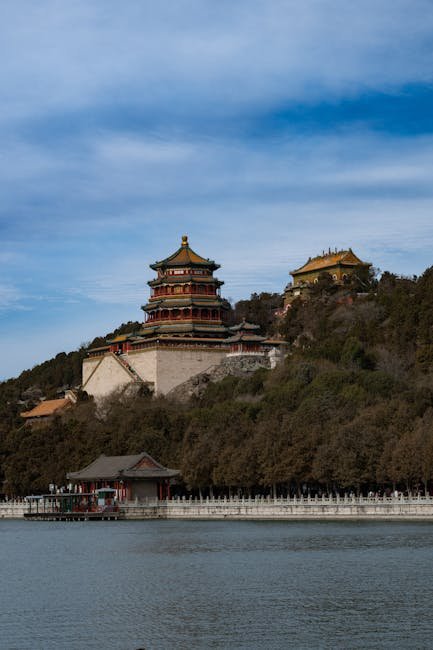
Longevity Hill (万寿山, Wan Shou Shan) is crowned by the Tower of Buddhist Incense (佛香阁, Fo Xiang Ge), a magnificent multi-story pavilion that is the visual centerpiece of the entire complex. The tower stands 41 meters tall on a 20-meter stone base, commanding views across the lake to the distant hills. Below the tower, a series of terraces descends the hillside, each level containing halls and pavilions that grow more ornate as the elevation increases. This vertical sequence from lake shore to hilltop is one of the most dramatic compositions in Chinese architecture.
Kunming Lake
Kunming Lake (昆明湖, Kunming Hu) is the centerpiece of the Summer Palace, covering 220 hectares. The lake was created by excavating earth that was used to build Longevity Hill, creating a classic Chinese garden feature — a large body of water with a hill rising behind it, symbolizing the Daoist paradise islands in the eastern sea. The lake is crossed by the Seventeen-Arch Bridge (十七孔桥, Shi Qi Kong Qiao), which connects the eastern shore to Nanhu Island. The bridge is 150 meters long, with its seventeen arches creating a graceful arc that reflects in the water below.
The Summer Palace was inscribed as a UNESCO World Heritage site in 1998, recognized as "a masterpiece of Chinese landscape garden design" that "integrates the natural landscape of hills and open water with manmade features such as pavilions, halls, palaces, temples, and bridges to form a harmonious ensemble of outstanding aesthetic value." It remains one of the most popular tourist destinations in China, attracting millions of visitors who come to experience the beauty of imperial garden design. The Summer Palace exemplifies a uniquely Chinese approach to monumental architecture — one where the designed landscape, rather than the individual building, is the primary work of art, and where built structures serve to frame and punctuate a larger composition of hills, water, and sky. The Long Corridor alone, with its 14,000 painted panels depicting scenes from Chinese literature and landscape, constitutes one of the world's most extensive integrated art-and-architecture installations.
The design philosophy behind the Summer Palace draws on ancient Chinese principles of borrowed scenery (借景, jie jing) that transform the distant Western Hills into an integral part of the garden's composition. The placement of every major structure — the Tower of Buddhist Incense crowning Longevity Hill, the Seventeen-Arch Bridge spanning the lake, the Jade Belt Bridge arcing in a perfect semicircle — was calculated to create specific views that extend far beyond the palace boundaries. This technique makes the Summer Palace feel infinitely larger than its actual dimensions, as the imperial landscape continuously draws the eye beyond the immediate foreground to the mountains on the horizon, creating a seamless continuity between the designed garden and the natural world.
Kunming Lake itself was not a natural body of water but an extraordinary feat of hydraulic engineering. Originally a spring-fed pond, it was expanded during the Qianlong emperor's renovation to its present 220-hectare size through the labor of 10,000 workers, with the excavated earth used to build Longevity Hill. The lake served multiple functions: a scenic centerpiece for the garden, a reservoir for Beijing's water supply, and a training ground for the imperial navy. The lake's water level was regulated by a complex system of sluice gates and channels connecting to Beijing's urban water network, demonstrating that the Summer Palace was not merely a pleasure garden but a strategic infrastructure project integrated into the capital's hydrological system.
The Summer Palace's turbulent history mirrors China's own journey through the nineteenth and twentieth centuries. In 1860, during the Second Opium War, British and French forces looted and burned the original palace buildings. Empress Dowager Cixi controversially diverted naval funds to rebuild it in 1886, a decision that contributed to China's defeat in the First Sino-Japanese War. Foreign forces damaged the palace again during the Boxer Rebellion of 1900. Each time, the palace was rebuilt, testifying to its symbolic importance in Chinese national identity. The current UNESCO World Heritage inscription, granted in 1998, recognizes the Summer Palace as "a masterpiece of Chinese landscape garden design" whose "natural landscape of hills and open water is combined with artificial features to form a harmonious ensemble of outstanding aesthetic value."
Several distinct structures within the Summer Palace merit particular attention for their architectural ingenuity. The Marble Boat (石舫, Shi Fang), a two-story pavilion built atop a 36-meter-long stone hull at the western edge of the lake, symbolizes the stability of the Qing dynasty in water — an ironic choice given its construction with funds diverted from the navy. The Jade Belt Bridge (玉带桥, Yu Dai Qiao), one of six bridges along the western causeway, rises in a high, single arch to allow dragon boats to pass beneath, its white marble form reflected as a perfect ellipse in the water below. The Hall of Joy and Longevity (乐寿堂, Le Shou Tang), Empress Dowager Cixi's private residence, features a spacious courtyard with a bronze deer, crane, and vase — symbols of longevity — and is connected to the lakefront by a private pier where the empress embarked on her daily pleasure cruises. The Garden of Virtue and Harmony (德和园, De He Yuan) contains the largest surviving imperial theater in China, a three-story stage with trap doors and a well beneath the stage floor for dramatic water effects, where Peking opera performances entertained the imperial household during summer evenings.
The Summer Palace offers visitors an experience that changes dramatically across the seasons, each revealing a different dimension of the garden's design. Spring brings peach and crabapple blossoms to the eastern shore, with the lake reflecting the tender pinks and whites against the emerging green of the willows. Summer is the peak season, when lotus flowers blanket the lake's edges and the shaded Long Corridor provides relief from the heat, while evening boat rides on Kunming Lake offer views of the Tower of Buddhist Incense lit against the dusk sky. Autumn paints the Garden of Harmonious Pleasures at the eastern base of Longevity Hill in shades of crimson and gold, with the clear autumn air sharpening the outlines of the Western Hills on the horizon. Winter reveals a more austere beauty — the lake freezes over, the bare branches of ancient pines frame the snow-covered pavilions, and the stillness allows visitors to appreciate the garden's spatial structure without the distraction of foliage and flowers. This seasonal transformation was intentional in the garden's design, ensuring that imperial patrons would find fresh pleasures on every visit throughout the year.
The Summer Palace also contains a remarkable reconstruction of a traditional Suzhou marketplace along the lake's northern shore, known as Suzhou Market Street (苏州街, Suzhou Jie). This 300-meter-long waterside street, with its flagstone pavements, wooden shopfronts, and arched bridges, was designed for Empress Dowager Cixi's entertainment — merchants and shoppers were played by palace eunuchs and maids in a daily performance of urban commercial life. The reconstruction of this street after its destruction in 1860 was carried out with careful attention to the architectural details of Qing dynasty commercial buildings, including the characteristic horse-head gables, lattice windows, and overhanging eaves that defined Suzhou's historic canal-side architecture. The market street offers visitors a rare opportunity to experience the texture of everyday commercial architecture from imperial China, preserved within the larger context of one of the world's most magnificent imperial gardens.
The Long Corridor
The Long Corridor (长廊, Chang Lang) is one of the Summer Palace's most celebrated features — a 728-meter covered walkway that runs along the northern shore of Kunming Lake, connecting the eastern and western sections of the palace. The corridor is supported by 273 bays, each framed by four columns, with a painted beam above every bay. In total, over 14,000 individual paintings decorate the beams, depicting scenes from Chinese classical literature, historical events, landscapes, flowers, and birds.
The Long Corridor serves both practical and aesthetic functions. It provides a shaded, weather-protected walkway between the palace's main buildings while creating a visual connection between the architecture and the lake. The corridor's east-west orientation means that natural light shifts throughout the day, changing the appearance of the paintings and creating a dynamic visual experience for the stroller. The four octagonal pavilions at intervals along the corridor represent the four seasons and provide resting points with framed views of the lake and hills.
Longevity Hill Structures
Longevity Hill (万寿山, Wan Shou Shan), rising behind the lakeside complex, is crowned by the Tower of Buddhist Incense (佛香阁, Fo Xiang Ge), a three-story octagonal pavilion that is the tallest building in the Summer Palace at 41 meters. The tower was built on a 20-meter stone platform, making it visible from every corner of the garden. From its upper floors, visitors can see the entire Summer Palace laid out below — Kunming Lake stretching to the southern horizon, the Western Hills in the distance, and the intricate network of halls, temples, and gardens at the foot of the hill.
Behind the Tower of Buddhist Incense, the Sea of Wisdom Temple (智慧海) crowns the summit, unique for being constructed entirely of glazed ceramic tiles without a single timber beam. The temple's exterior is covered with yellow, green, purple, and blue tiles, each featuring a niche containing a small Buddha statue. The contrast between the ceramic temple at the summit and the timber structures lower on the hill demonstrates the Qing dynasty builders' mastery of multiple construction materials and techniques within a single landscape composition.
Garden Design Principles
The Summer Palace exemplifies the highest achievement of Chinese imperial garden design. The fundamental principle is the integration of the natural landscape with architectural elements, creating a seamless composition in which buildings appear to grow organically from their setting. The use of "borrowed scenery" (借景, jie jing) incorporates distant landmarks — the Western Hills and the Jade Spring Pagoda — into the garden's visual field, making the palace appear to extend infinitely beyond its actual boundaries.
Another key principle is the creation of multiple viewing perspectives. From the lake, the hilltop pagoda appears as the focal point of the composition; from the hill, the lake becomes a mirror reflecting the sky; from the Long Corridor, framed views reveal carefully composed scenes that change with each step. The Summer Palace was inscribed as a UNESCO World Heritage site in 1998, recognized as a masterpiece of Chinese landscape garden design that integrates natural landscape with man-made features to form a harmonious ensemble of outstanding aesthetic value.