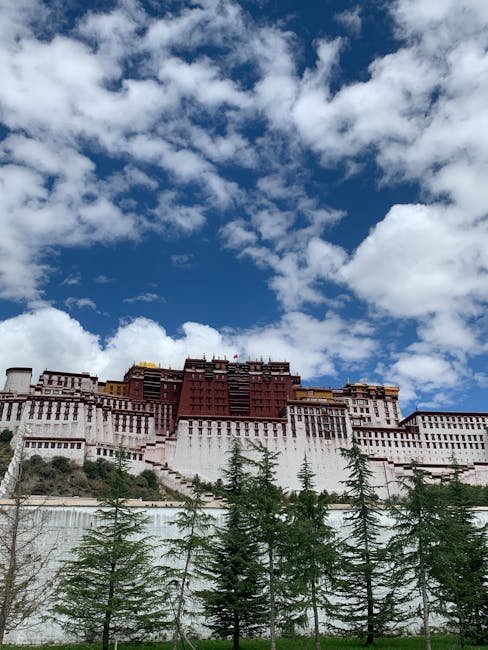
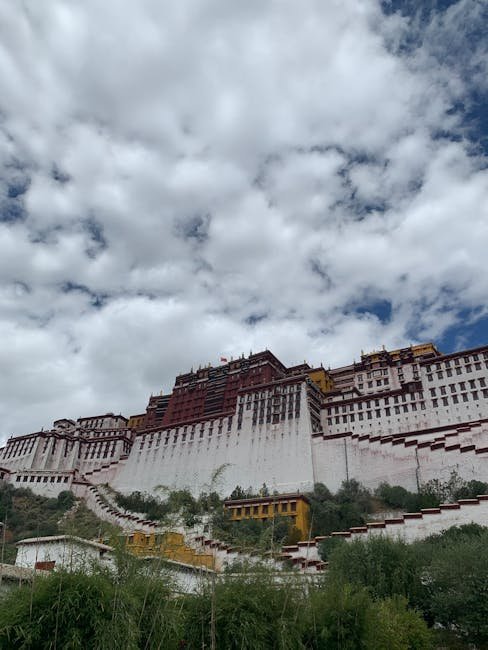
The iconic thirteen-story palace of the Dalai Lamas, rising above Lhasa as the supreme symbol of Tibetan Buddhist culture.
The Potala Palace (布达拉宫, Bu Da La Gong), perched on Red Mountain (红山, Hong Shan) at an elevation of 3,700 meters in Lhasa, Tibet, is one of the most iconic buildings in the world. This massive thirteen-story palace complex, covering 130,000 square meters, has served as the winter palace of the Dalai Lamas, the spiritual and temporal center of Tibetan Buddhism, and the most recognizable symbol of Tibetan culture and architecture. The Potala is not merely a palace but a sacred mountain made architectural — a physical embodiment of the Tibetan Buddhist cosmos.
History and Construction
The Potala's history begins in the seventh century CE, when King Songtsen Gampo of the Tibetan Empire built a palace on Red Mountain to celebrate his marriage to the Chinese Princess Wencheng. This original palace was destroyed during the power struggles of the ninth century, and the site lay in ruins for nearly 800 years. The present structure was begun in 1645 by the Fifth Dalai Lama, Lobsang Gyatso, who united Tibet under his rule and needed a palace worthy of his political and spiritual authority. Construction continued for over fifty years, with the Potala reaching its present form in 1694.
The Potala is divided into two main sections: the White Palace (白宫, Bai Gong) and the Red Palace (红宫, Hong Gong). The White Palace, built between 1645 and 1653, contains the living quarters, administrative offices, and reception halls of the Dalai Lamas. The Red Palace, added between 1690 and 1694, contains the sacred chapels, assembly halls, and the burial stupas of eight Dalai Lamas. The Red Palace is the spiritual heart of the complex, its deep red color symbolizing power and protection in Tibetan Buddhist tradition.
"The Potala Palace is not a building in the ordinary sense — it is a sacred mountain, a mandala made architectural, a three-dimensional representation of the Buddhist cosmos. From its foundation on Red Mountain to its golden stupas piercing the sky, every element of the Potala is infused with spiritual meaning."
Architectural Features
The Potala's architecture embodies the principles of Tibetan building at their highest level. The exterior walls slope inward as they rise, a characteristic feature of Tibetan architecture that gives the palace its solid, grounded appearance. The walls are painted white for the palace section and red for the sacred section, using natural pigments that withstand the harsh plateau climate. The windows are framed in black — the color of the protective deity Mahakala — with narrow openings that reduce solar gain while framing views of the surrounding mountains.
The Potala contains over 1,000 rooms, including temples, chapels, living quarters, administrative offices, and burial stupas. The passageways are lined with murals depicting scenes from Buddhist scripture and Tibetan history, with the total mural area exceeding 2,500 square meters. The most sacred spaces are the stupa chapels in the Red Palace, where eight stupas containing the embalmed bodies of Dalai Lamas are enshrined. The largest stupa, that of the Fifth Dalai Lama, stands 14.85 meters tall and is covered in 3,700 kilograms of gold leaf, inlaid with precious gems.
Contemporary Significance
The Potala Palace was inscribed as a UNESCO World Heritage site in 1994, recognized as "a masterpiece of Tibetan architecture" that "integrates the functions of a palace and a monastery in a building of outstanding historical and artistic value." Today, the Potala is a museum, open to the public as one of China's most popular tourist attractions. Visitors climb the 108 steps from the base to the entrance, passing through the massive gate to explore the labyrinthine corridors, chapels, and halls that constitute this extraordinary building.
For anyone interested in world architecture, the Potala Palace is an essential destination. It represents the highest achievement of Tibetan Buddhist architecture, a building that is simultaneously a palace, a monastery, a fortress, and a sacred mountain. Its location — rising from the Lhasa valley floor, set against the stark beauty of the Tibetan plateau — gives it a visual impact that no photograph can fully capture. The Potala is not just a building but a symbol of Tibetan culture and spirituality, a monument to the human capacity to create beauty and meaning in the most challenging environments on earth.