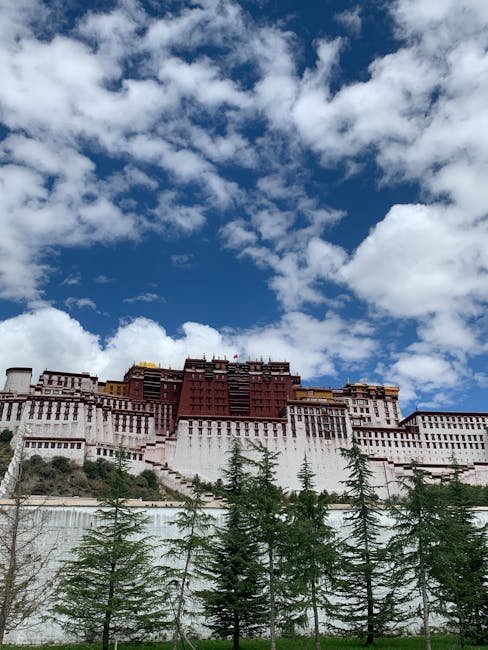
The Potala Palace (布达拉宫, Bu Da La Gong), perched on Red Mountain (红山, Hong Shan) at an elevation of 3,700 meters in Lhasa, Tibet, is one of the most iconic buildings in the world. This massive thirteen-story palace complex, covering 130,000 square meters, has served as the winter palace of the Dalai Lamas, the spiritual and temporal center of Tibetan Buddhism, and the most recognizable symbol of Tibetan culture and architecture. The Potala is not merely a palace but a sacred mountain made architectural — a physical embodiment of the Tibetan Buddhist cosmos.
History and Construction
The Potala's history begins in the seventh century CE, when King Songtsen Gampo of the Tibetan Empire built a palace on Red Mountain to celebrate his marriage to the Chinese Princess Wencheng. This original palace was destroyed during the power struggles of the ninth century, and the site lay in ruins for nearly 800 years. The present structure was begun in 1645 by the Fifth Dalai Lama, Lobsang Gyatso, who united Tibet under his rule and needed a palace worthy of his political and spiritual authority. Construction continued for over fifty years, with the Potala reaching its present form in 1694.
The Potala is divided into two main sections: the White Palace (白宫, Bai Gong) and the Red Palace (红宫, Hong Gong). The White Palace, built between 1645 and 1653, contains the living quarters, administrative offices, and reception halls of the Dalai Lamas. The Red Palace, added between 1690 and 1694, contains the sacred chapels, assembly halls, and the burial stupas of eight Dalai Lamas. The Red Palace is the spiritual heart of the complex, its deep red color symbolizing power and protection in Tibetan Buddhist tradition.
"The Potala Palace is not a building in the ordinary sense — it is a sacred mountain, a mandala made architectural, a three-dimensional representation of the Buddhist cosmos. From its foundation on Red Mountain to its golden stupas piercing the sky, every element of the Potala is infused with spiritual meaning."
Architectural Features
The Potala's architecture embodies the principles of Tibetan building at their highest level. The exterior walls slope inward as they rise, a characteristic feature of Tibetan architecture that gives the palace its solid, grounded appearance. The walls are painted white for the palace section and red for the sacred section, using natural pigments that withstand the harsh plateau climate. The windows are framed in black — the color of the protective deity Mahakala — with narrow openings that reduce solar gain while framing views of the surrounding mountains.
The Potala contains over 1,000 rooms, including temples, chapels, living quarters, administrative offices, and burial stupas. The passageways are lined with murals depicting scenes from Buddhist scripture and Tibetan history, with the total mural area exceeding 2,500 square meters. The most sacred spaces are the stupa chapels in the Red Palace, where eight stupas containing the embalmed bodies of Dalai Lamas are enshrined. The largest stupa, that of the Fifth Dalai Lama, stands 14.85 meters tall and is covered in 3,700 kilograms of gold leaf, inlaid with precious gems.
Contemporary Significance
The Potala Palace was inscribed as a UNESCO World Heritage site in 1994, recognized as "a masterpiece of Tibetan architecture" that "integrates the functions of a palace and a monastery in a building of outstanding historical and artistic value." Today, the Potala is a museum, open to the public as one of China's most popular tourist attractions. Visitors climb the 108 steps from the base to the entrance, passing through the massive gate to explore the labyrinthine corridors, chapels, and halls that constitute this extraordinary building.
For anyone interested in world architecture, the Potala Palace is an essential destination. It represents the highest achievement of Tibetan Buddhist architecture, a building that is simultaneously a palace, a monastery, a fortress, and a sacred mountain. Its location — rising from the Lhasa valley floor, set against the stark beauty of the Tibetan plateau — gives it a visual impact that no photograph can fully capture. The Potala is not just a building but a symbol of Tibetan culture and spirituality, a monument to the human capacity to create beauty and meaning in the most challenging environments on earth. At an elevation of 3,700 meters, the very act of constructing the Potala required extraordinary logistical planning — all stone, timber, and clay were carried up to Red Mountain by human and animal labor, and the building's immense mass rests on foundations anchored deep into the mountain's granite core. The fact that this architectural marvel was achieved without modern machinery, at altitude, in one of the world's most extreme climates, stands as one of humanity's great construction achievements.
The Potala's construction techniques reflect sophisticated adaptations to the extreme Tibetan environment. The walls, built of stone and rammed earth, taper inward as they rise — from over five meters thick at the base to approximately two meters at the parapet — providing both structural stability and thermal mass that moderates interior temperatures in a climate where winter nights routinely drop below minus twenty degrees Celsius. The exterior surfaces are coated with a mixture of lime, milk, honey, and sugar that is poured from the top, flowing down the walls to create a hard, weatherproof finish that withstands ultraviolet radiation and freeze-thaw cycles. This traditional technique, maintained by specialist artisans, requires reapplication approximately every five years and represents a continuous building tradition stretching back to the palace's founding in the seventh century.
The Potala's interior spaces reveal a sophisticated understanding of environmental psychology. The progression from the bright, thin-air exterior to the dim, incense-fragrant chapels creates a deliberate sensory transformation that prepares visitors for spiritual experience. The narrow passages, steep stairs, and sudden openings into lambent chapel spaces manipulate the body's movement and the eye's adaptation to reinforce the transition from the mundane to the sacred. This choreographed sequence of compression and release, darkness and illumination, is a spatial strategy found in sacred architecture across cultures — from Egyptian temples to Gothic cathedrals — but realized at the Potala with a uniquely Tibetan vocabulary of space, light, and material
The eight burial stupas enshrined within the Red Palace represent some of the most extraordinary works of funerary art in the Buddhist world. Each stupa is a three-dimensional mandala, its form following the canonical proportions prescribed in Tibetan Buddhist texts — a square base representing the earth, a circular dome representing water, a conical spire representing fire, a parasol representing air, and a jewel at the apex representing the void or pure awareness. The stupas range in height from 6 to 15 meters, each constructed from a wooden core clad in silver and gold sheet, then inlaid with turquoise, lapis lazuli, coral, amber, and pearls. The largest, dedicated to the Fifth Dalai Lama, required 3,700 kilograms of gold leaf and is set within a chapel that occupies the full height of the Red Palace's four upper stories. The embalmed bodies within were treated with salt, sandalwood, and precious substances according to rituals that preserve the form of the meditating master, seated in the lotus position, facing east toward the rising sun.
The Potala Palace has profoundly influenced Tibetan Buddhist architecture across the Himalayan region. Monasteries and palaces from Ladakh to Bhutan adopted elements of its design — the inward-sloping battered walls, the black-framed windows, the flat roofs with corner stupas, and the stark color contrast between white secular and red sacred sections. The Tashichho Dzong in Thimphu, Bhutan, the royal palace in Gangtok, Sikkim, and the major monasteries of the Gelug school throughout Tibet all bear the Potala's architectural DNA. The preservation of the Potala requires continuous effort — the high-altitude environment subjects the structure to extreme temperature swings, ultraviolet radiation, and the stress of permafrost thaw beneath its foundations. Major restoration campaigns in 1989-1994 and 2002-2008 addressed structural instability, water infiltration, and deteriorating murals, using traditional materials and techniques documented from the original construction. These restoration efforts represent the largest conservation project ever undertaken on a Tibetan building, and their methods have established protocols for heritage preservation across the entire Himalayan region.
The Potala Palace's urban role within Lhasa is as significant as its architectural form. The palace dominates the city's skyline, visible from every rooftop and ridge in the Lhasa valley, serving as a constant visual reminder of the centrality of Buddhism in Tibetan life. The circular kora (ritual circumambulation) route that encircles the palace and Red Mountain is worn smooth by centuries of pilgrims' footsteps and continues to be used daily by devout Tibetans spinning prayer wheels as they walk. The streets and neighborhoods at the foot of the palace were traditionally home to the families who served the Potala's monastic community, creating an organic urban fabric of shrines, tea houses, and craft workshops that sustained the palace's spiritual and material needs. This integration of the monumental palace with the everyday life of the surrounding city — the sacred mountain at the center of a living, working community — represents an urban model fundamentally different from the isolated temple compounds typical of other Buddhist traditions, and is essential to understanding the Potala's full architectural and cultural significance.
The White Palace
The White Palace (白宫, Bai Gong), the first built section of the Potala, contains the living quarters, administrative offices, and reception halls of the Dalai Lamas. Its seven stories rise above the eastern section of Red Mountain, with the distinctive whitewashed walls that give the palace its characteristic appearance. The white color symbolizes wisdom and peace in Tibetan Buddhist tradition, and the whitewashing process — a mixture of lime, milk, honey, and sugar applied annually — is a ritual performed by pilgrims as an act of devotion.
The most important room in the White Palace is the Great Eastern Hall (东大殿), the largest assembly space in the Potala, used for major ceremonies and audiences. The hall is decorated with elaborate murals depicting the history of Buddhism in Tibet, the life of the Dalai Lamas, and scenes from the building of the Potala itself. The throne of the Dalai Lama occupies the center of the hall, surrounded by pillars wrapped in silk brocade, creating an interior of extraordinary richness and ceremonial dignity.
The Red Palace
The Red Palace (红宫, Hong Gong), added between 1690 and 1694, is the spiritual heart of the Potala complex. Its deep red color symbolizes power and protection in Tibetan Buddhist tradition. The Red Palace contains numerous chapels, assembly halls, and most importantly, the burial stupas (chortens) of eight Dalai Lamas. Each stupa is a monumental structure, the largest being that of the Fifth Dalai Lama, which stands over 14 meters high and is plated with nearly 4,000 kilograms of gold.
The chapels within the Red Palace house an extraordinary collection of Buddhist art: thangka paintings, embroidered silk banners, jeweled ritual implements, and thousands of statues of Buddhas, bodhisattvas, and protective deities. The walls are covered with murals that narrate the life of Buddha Shakyamuni, the history of Tibetan Buddhism, and the construction of the Potala itself. The combination of architecture, painting, sculpture, and ritual objects makes the Red Palace a complete work of Buddhist art.
Conservation and Access
The Potala Palace was inscribed as a UNESCO World Heritage site in 1994 and has since undergone extensive conservation work. The high altitude and extreme climate of Lhasa — intense UV radiation, temperature swings, and seasonal monsoon rains — create preservation challenges unique among World Heritage sites. The painted exterior surfaces require frequent maintenance, and the internal timber structures need protection from both dry rot and insect damage in the specific conditions of the Tibetan plateau.
Today, the Potala operates as a museum, receiving a limited number of daily visitors to protect its fragile interior. Strict visitor management systems control access to the most sacred chapels, and conservation teams work year-round to stabilize the structure and preserve its art. For those who make the pilgrimage to Lhasa, the Potala remains an unforgettable experience — a building that seems to grow from the mountain itself, embodying in physical form the spiritual aspirations of Tibetan civilization and the extraordinary craft traditions that brought them to life.