The Humble Administrator's Garden (拙政园, Zhuo Zheng Yuan) is the largest and most famous of Suzhou's classical gardens, and one of the most celebrated works of Chinese garden art. Built in 1509 during the Ming dynasty by the imperial censor Wang Xianchen, the garden takes its name from a poem by the Jin dynasty scholar Pan Yue about "the humble administrator who enjoys a simple life of planting trees and building his house." The name expresses the ideal of the retired scholar-official who withdraws from public life to cultivate his garden and his mind.
Garden Layout
The Humble Administrator's Garden covers approximately 5.2 hectares and is divided into three distinct sections: the eastern, central, and western gardens. The eastern garden is characterized by open spaces, wide lawns, and a large lotus pond, creating an atmosphere of expansive tranquility. The central garden is the heart of the complex, organized around a large lake with islands connected by bridges, pavilions overlooking the water, and viewing points that frame carefully composed scenes. The western garden is more intimate, with smaller buildings, winding corridors, and secluded courtyards that provide spaces for quiet contemplation.
The garden contains thirty-one buildings, forty-eight bridges, and numerous rockeries, ponds, and plantings arranged according to the principles of Chinese garden design. The buildings are positioned to frame specific views, with doors and windows serving as "picture frames" that capture carefully composed scenes. The circulation paths are designed to reveal the garden gradually, with each turn and bend presenting a new vista. This sequential unfolding of views is the essence of Chinese garden design, creating an experience that engages the visitor both physically and aesthetically.
"The Humble Administrator's Garden is the finest example of the Suzhou garden tradition, a work of art in which architecture, landscape, painting, and poetry are fused into a seamless whole. Every visitor experiences the garden differently, because the garden reveals itself gradually, inviting personal interpretation and emotional response. This is the highest achievement of Chinese garden art — not a fixed composition but a living work that changes with the seasons and with the viewer."
Architecture and Water
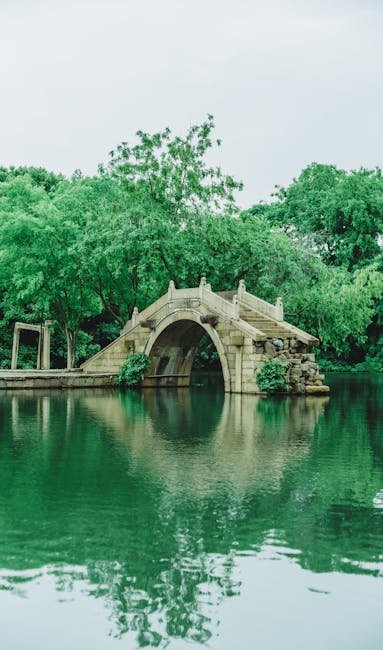
Water is the defining element of the Humble Administrator's Garden. The central lake occupies about one-third of the garden's area, with its surface reflecting the sky, buildings, and trees to create an ever-changing composition of light and shadow. Pavilions are positioned at the water's edge, their reflections shimmering in the surface below. The "Fragrant Isle" (香洲, Xiang Zhou) is a stone boat pavilion that projects into the lake, creating the illusion of a vessel floating on the water. The "Small Flying Rainbow" (小飞虹, Xiao Fei Hong) is a covered bridge that spans a narrow section of the lake, its reflection forming a complete circle with the bridge itself.
The buildings of the Humble Administrator's Garden are masterpieces of Suzhou garden architecture. The "Hall of Distant Fragrance" (远香堂, Yuan Xiang Tang) is the main building, named for the lotus blossoms whose fragrance drifts into the hall in summer. The "Pavilion of the Drunken Old Man" (醉翁亭, Zui Weng Ting) provides a vantage point for viewing the entire garden. The "Pavilion of Profound Thought" (深思亭, Shen Si Ting) is a quiet retreat for meditation. Each building is designed to serve a specific function while contributing to the garden's overall composition.
Cultural Significance
The Humble Administrator's Garden has been celebrated in Chinese literature and art for centuries. Countless poems, paintings, and essays have been inspired by its beauty, and it has served as a model for garden designers throughout East Asia. The garden was inscribed as a UNESCO World Heritage site in 1997 as part of the "Classical Gardens of Suzhou" designation, recognized for its "exceptional testimony to the cultural tradition of Chinese landscape design." Today, it receives over three million visitors annually and remains the most popular of Suzhou's classical gardens.
For anyone interested in Chinese garden art, a visit to the Humble Administrator's Garden is essential. The garden offers an experience of beauty, tranquility, and cultural depth that is unparalleled in Chinese garden design. Every season brings a different garden — spring with its plum blossoms and cherry trees, summer with its lotus blooms, autumn with its maple leaves and chrysanthemums, winter with its bare branches and snow-covered roofs. The garden is never the same twice, which is why visitors return again and again. The garden's enduring appeal lies in its demonstration that the most profound aesthetic experiences can arise from the careful composition of simple elements — water, rock, vegetation, and modest architecture — arranged not to dominate but to reveal, not to impress but to invite contemplation.
The design principles embodied in the Humble Administrator's Garden represent a mature philosophical tradition in which architecture, landscape, and poetry interpenetrate. The garden's creator, Wang Xianchen, was a Ming dynasty official who, disillusioned with court politics, retired to Suzhou to cultivate the scholar's ideal of reclusive self-cultivation. The garden's very name — "humble administrator" — is a self-deprecating reference to this ideal, adopted from an essay by the Jin dynasty poet Pan Yue. Every view within the garden is composed according to the principle of "borrowed scenery" (借景, jie jing), in which distant mountains, neighboring pagodas, and even the changing sky become integral elements of the garden's composition. This technique dissolves the boundary between the garden and the world beyond, making the limited space of the walled enclosure feel boundless.
Contemporary landscape architecture has much to learn from the Suzhou garden tradition. In an era of ecological crisis, the Suzhou garden's approach — working with water rather than draining it, preserving existing trees and topography rather than bulldozing them, creating habitat for diverse species within the garden's microclimate — aligns with modern principles of sustainable landscape design. The garden's reliance on local materials, its closed-loop water system, and its creation of microclimates through careful placement of walls, water, and vegetation offer practical models for environmentally responsive landscape design that are, remarkably, fully realized examples of principles that contemporary designers are only now rediscovering
The garden reveals itself differently through each season, a deliberate design strategy that ensures every visit offers a unique experience. In early spring, the plum blossoms near the eastern garden entrance herald the new year with their delicate pink and white petals, followed by cherry blossoms along the lakeside paths. Summer belongs to the lotus — the central lake becomes a carpet of broad green leaves and towering pink and white blooms, their fragrance drifting into the Hall of Distant Fragrance and the waterside pavilions. The distinctive seed pods of the lotus, which resemble shower heads, dry through late summer and provide architectural interest well into autumn. Autumn transforms the garden into a palette of reds, oranges, and golds as the maple trees lining the western garden pathways reach their peak color, framed by the dark green of the evergreen pines and the silvery-gray of the Taihu rockeries. Winter reveals the garden's skeletal beauty — the bare branches of deciduous trees creating intricate patterns against the whitewashed walls, the stone boat pavilion standing quietly against the gray lake, and the occasional snowfall softening every sharp edge. The garden's covered corridors, designed for year-round use, allow visitors to experience every season in comfort, with each framed window and moon gate offering a different seasonal painting.
The influence of the Humble Administrator's Garden extends far beyond Suzhou's city walls. The garden's design principles were exported to Japan during the Ming and Qing dynasties, where they influenced the development of the Japanese stroll garden (kaiyu-shiki teien) and can be seen in gardens such as Katsura Imperial Villa in Kyoto. Korean scholar-officials who visited Suzhou during tributary missions brought back garden manuals and paintings that shaped the development of Korean traditional gardens. In the West, the Suzhou garden aesthetic reached Europe through the reports of Jesuit missionaries in the 18th century and directly influenced the Anglo-Chinese garden style that swept through England and France, exemplified by the Jardins de Bagatelle in Paris and the Royal Botanic Gardens at Kew. Today, the Humble Administrator's Garden has inspired full-scale replicas and interpretive gardens around the world, from the Metropolitan Museum of Art's Astor Chinese Garden Court in New York to the Liu Fang Yuan at the Huntington Library in California, proving that the principles of Chinese garden design remain as compelling in the 21st century as they were in the Ming dynasty.
The garden's collection of Taihu rocks (太湖石), gathered from the bottom of Lake Tai near Suzhou, represents the most sophisticated use of scholar's stones in any Chinese garden. These limestone formations, naturally eroded by water over millennia into fantastic shapes characterized by four aesthetic qualities — thinness (shou), perforation (tou), wrinkling (zhou), and leakage (lou) — were selected individually and positioned as sculptural elements throughout the garden. The most famous cluster, known as the "Cloud-Capped Peak," stands over five meters tall and dominates the central garden's western section. These rocks were transported from Lake Tai by barge through the Grand Canal network, a logistical achievement possible only because Suzhou's position as a canal hub gave its garden builders access to materials from across the empire. The rocks embody the Daoist aesthetic of the "un-carved block" — the idea that the most profound beauty emerges not from human intervention but from the revelation of nature's inherent forms.
Taihu Rocks and Scholar's Stones
The garden's collection of Taihu rocks (太湖石), gathered from Lake Tai near Suzhou, represents the most sophisticated use of scholar's stones in any Chinese garden. These limestone formations, naturally eroded by water over millennia into fantastic shapes, were selected individually and positioned as sculptural elements throughout the garden. The most famous cluster, the "Cloud-Capped Peak," stands over five meters tall and dominates the central garden's western section.
These rocks were transported from Lake Tai by barge through the Grand Canal network, a logistical achievement possible only because Suzhou's canal hub position gave builders access to materials from across the empire. The rocks embody the Daoist aesthetic of the "un-carved block" — the belief that the most profound beauty emerges not from human intervention but from the revelation of nature's inherent forms. Each stone is prized for four qualities: thinness (shou), perforation (tou), wrinkling (zhou), and leakage (lou).
Garden Design Principles
The Humble Administrator's Garden exemplifies the foundational principles of Chinese garden design. "Borrowed scenery" (借景, jie jing) incorporates distant landmarks — the North Temple Pagoda outside the garden walls — into the garden's visual composition, making the garden appear larger than its actual boundaries. "Contrast and complement" (对比, dui bi) creates dramatic juxtapositions of light and shadow, open water and dense foliage, straight paths and winding bridges.
"View-changing with each step" (移步换景, yi bu huan jing) ensures that the garden reveals itself gradually, with each turn of a path or crossing of a bridge offering a completely new perspective. These principles transform the garden from a static space into a dynamic experience that unfolds over time, inviting the visitor into a contemplative dialogue with the landscape that is the essence of the Chinese garden art tradition.
Global Influence
The influence of the Humble Administrator's Garden extends far beyond Suzhou. The garden's design principles were exported to Japan, Korea, and Europe, shaping the development of the Japanese stroll garden, Korean traditional gardens, and the Anglo-Chinese garden style that swept through England and France in the 18th century. The Metropolitan Museum of Art's Astor Chinese Garden Court in New York and the Liu Fang Yuan at the Huntington Library in California are direct descendants of this tradition.
Today, as a UNESCO World Heritage site, the garden receives millions of visitors annually from around the world, who come to experience the harmony of architecture, water, and vegetation that defines the classical Chinese garden. Its continued relevance demonstrates that the principles of Chinese garden design — the integration of built and natural elements, the creation of microcosmic landscapes, and the use of space to evoke emotion and contemplation — speak to universal human needs that transcend culture and time.