Classical Chinese interior design (古典中式, gu dian zhong shi) represents the traditional aesthetic of Chinese domestic interiors as it developed over centuries of imperial rule, reaching its mature form during the Ming (1368-1644) and Qing (1644-1912) dynasties. This style is characterized by the use of precious hardwoods, particularly rosewood (hongmu) and mahogany, elaborate carving and joinery, the deployment of screens and display cabinets as spatial organizers, and a rich vocabulary of decorative objects that convey the owner's status, education, and cultural refinement.
The Literati Aesthetic
The classical Chinese interior was shaped by the values of the scholar-official class (士大夫, shi da fu), who were the cultural arbiters of traditional China. The ideal interior according to the literati aesthetic was not ostentatiously wealthy but rather "elegant and refined" (雅致, ya zhi), expressing the owner's cultivation through the quality and selection of objects rather than their quantity or cost. A well-appointed study (书房, shu fang) was the heart of the literati home, containing a scholar's desk, bookshelves, a calligraphy table, and objects d'art such as brush pots, ink stones, and scholar's rocks that reflected the owner's taste.
The literati aesthetic valued the antique over the new, the subtle over the obvious, and the natural over the artificial. A Ming dynasty rosewood chair was prized for the quality of its wood and the precision of its joinery; a painting by a Song dynasty master was valued for the depth of its brushwork and the subtlety of its composition. This appreciation for quality and authenticity meant that classical Chinese interiors were often more restrained than Western conceptions of "Chinese style" might suggest, with carefully chosen objects displayed with generous space around them.
"A room should not be crowded with furniture and objects. Each piece should be chosen for its quality and meaning, and should be given space to be seen and appreciated. The classical Chinese interior is not a display of wealth but a reflection of the owner's mind — a mind that values quality over quantity, meaning over appearance, and beauty over decoration."
Key Elements
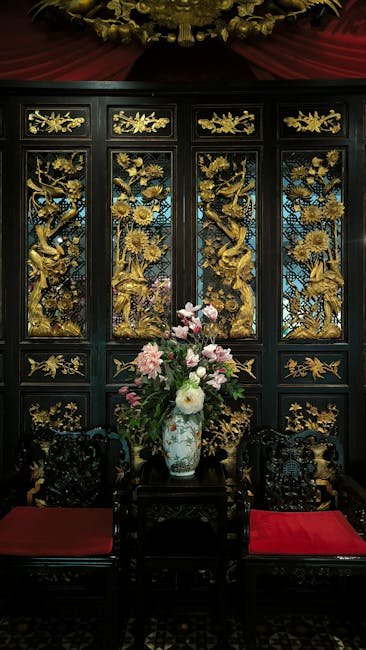
Several elements characterize the classical Chinese interior. The rosewood furniture (红木家具, hongmu jiaju) is the centerpiece, with pieces such as the armchair (太师椅, taishi yi), the yoke-back chair (官帽椅, guanmao yi), and the rectangular table (条案, tiao an) displaying the exquisite craftsmanship of Chinese furniture makers. The folding screen (屏风, ping feng) serves as a movable architectural element, dividing space, providing privacy, and creating a backdrop for the display of art and objects.
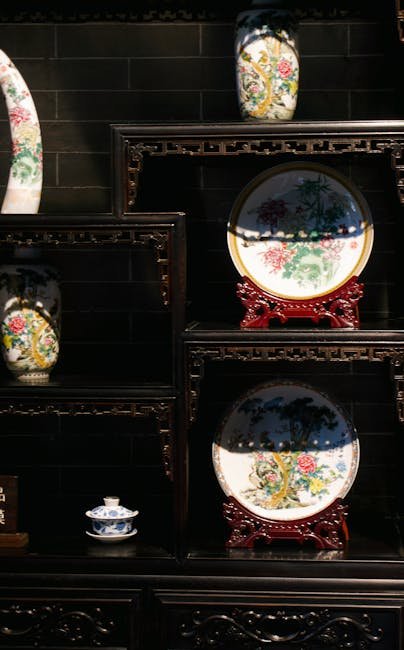
Display cabinets (多宝格, duo bao ge) are distinctive Chinese furniture pieces designed for the exhibition of small treasures — porcelains, jades, bronzes, and curios. These cabinets feature numerous compartments of varying sizes and shapes, creating a visually interesting display surface while protecting the objects within. The "treasure cabinet" is a microcosm of the collector's mind, with each compartment holding a carefully chosen object that rewards close inspection.
Materials and Color
The classical Chinese interior is dominated by the warm, rich colors of precious hardwoods — rosewood ranges from deep purple-brown to reddish-brown, while nanmu (楠木) has a golden-yellow hue. These woods are finished with clear lacquer that protects the surface while allowing the natural grain to show through. The walls are typically white or off-white, providing a neutral backdrop for the furniture and artworks. Flooring may be of wood, stone, or ceramic tile, often partially covered with silk or wool rugs.
Accent colors are drawn from the traditional Chinese palette: the deep red of lacquerware, the blue of Qing dynasty porcelain, the green of celadon, and the gold of gilt bronzes. These colors appear in decorative objects, textile accents, and sometimes in painted architectural elements such as beam decorations. The overall effect is an interior that feels warm, luxurious, and deeply connected to Chinese cultural tradition — a space that has been refined over centuries into an expression of beauty and meaning.
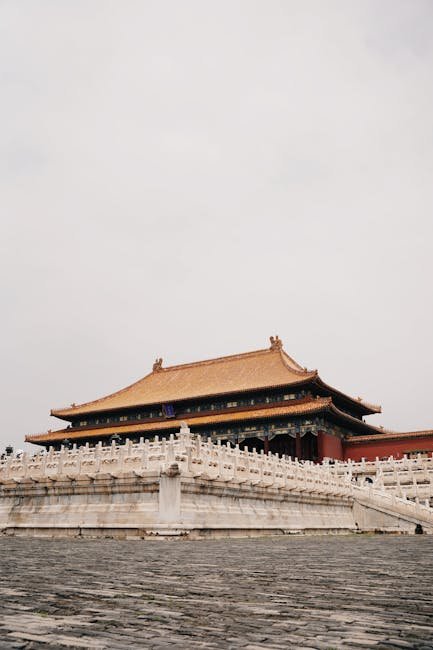
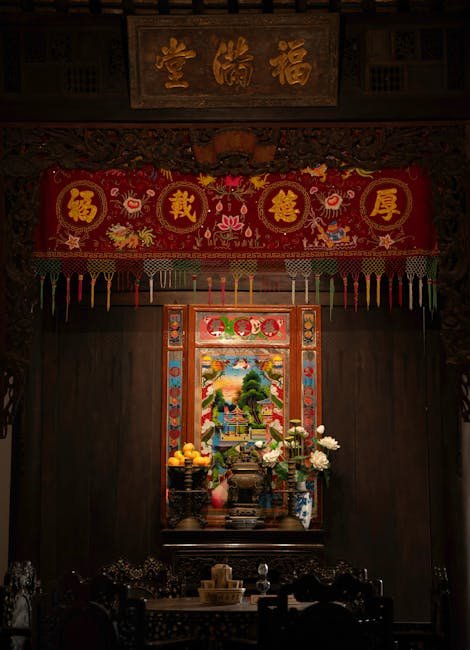
The spatial organization of classical Chinese interiors follows principles fundamentally different from Western interior design. Rather than arranging furniture symmetrically against walls in the European manner, Chinese interiors organize space around a central axis that runs from the entrance to the principal seat. The main pieces — the altar table, the armchairs for the household heads — occupy the position of honor along this axis, while subsidiary seating and smaller furnishings radiate outward. This axial arrangement reflects the same spatial logic found in Chinese architecture at every scale, from the imperial city to the private garden, creating interiors that guide movement and hierarchy through spatial ordering rather than through walls and doors.
The relationship between interior and garden is another defining characteristic lost in most contemporary interpretations. In the classical Chinese home, large lattice windows and door openings dissolve the boundary between inside and outside, making the garden's rocks, plants, and water features integral components of the interior composition. A scholar seated at his desk could look through a moon gate window to a strategically placed Taihu rock or a flowering prunus branch, each view composed as carefully as a landscape painting. This integration of interior and exterior space — achieved without the modernist glass wall — represents one of Chinese architecture's most sophisticated contributions to spatial design.
The classical Chinese interior cannot be understood in isolation from the social rituals it accommodated. The formal reception of guests followed elaborate protocols governing seating, tea service, and conversation — all encoded in the spatial organization of the main hall. Furniture was arranged for ceremonial propriety rather than casual comfort: hosts occupied chairs flanking the central altar table, while guests of varying status were seated at calculated distances along the side walls. The choice of decorative objects — a bronze ritual vessel, a master's landscape painting, an exceptional celadon vase — communicated the host's cultivation, taste, and social connections. Every element of the classical Chinese interior was freighted with meaning, and reading a room correctly required the same cultural literacy as reading a classical text.
The Ming dynasty essayist Wen Zhenheng, in his Treatise on Superfluous Things (长物志, c. 1620), provided detailed guidance on furnishing the scholar's study that remains instructive today. Wen advised against overcrowding, symmetrical arrangements he found stiff and institutional, and display of objects purely for monetary value. He advocated studied asymmetry, seasonal rotation of objects to reflect the changing natural world, and inclusion of imperfect pieces whose flaws invited contemplation — a concept remarkably aligned with the Japanese wabi-sabi aesthetic that developed from shared Chinese cultural roots. Wen's treatise reminds us that the classical Chinese interior was never a static formula but a living tradition of taste and discernment, constantly debated and refined by generations of scholars, collectors, and connoisseurs
The arrangement of furniture within the classical Chinese interior followed principles fundamentally different from Western conventions. Where Western interiors tended to position furniture against walls, creating a central open space for movement, the classical Chinese interior placed furniture in symmetrically arranged groups, often with the principal seat facing south — the direction of imperial authority and favorable feng shui. The scholar's desk faced the entrance but was positioned at an oblique angle, allowing the scholar to see visitors approaching while maintaining an appropriate degree of separation. Chairs were arranged in pairs flanking a central table, with the most senior person seated farthest from the door. This spatial hierarchy, invisible to the uninitiated, governed every aspect of interior arrangement and encoded the Confucian social relationships that structured traditional Chinese domestic life. Understanding this spatial code is essential to understanding how the classical Chinese interior functioned not merely as a setting for domestic life but as a physical embodiment of the social and philosophical order that gave Chinese civilization its distinctive character.
The sensory experience of the classical Chinese interior was carefully orchestrated across all five senses, creating a total environment that engaged the occupant at every level. The visual field was composed through the careful arrangement of furniture, the play of light through lattice windows, and the strategic placement of calligraphy and painting scrolls that could be rotated seasonally. The tactile experience was equally considered: the silky smoothness of aged rosewood, the coolness of celadon ceramics, the slight give of a woven bamboo mat beneath the feet. Scent was provided by incense burners that released sandalwood, agarwood, or jasmine fragrance depending on the time of day and the activity taking place. Ambient sound consisted of wind chimes at the eaves, the trickle of water from the courtyard fountain, and the occasional note from a zither. This multi-sensory design philosophy, which Chinese scholars called "the realm of meaning beyond form" (象外之意), elevated the interior from a mere shelter into an instrument for refining perception and cultivating the mind — an approach to living that continues to inspire designers seeking to create spaces that engage the whole person rather than the eye alone.
The continued relevance of classical Chinese interior principles is evident in the work of contemporary designers who adapt traditional spatial concepts for modern living. The principle of "borrowed scenery" (借景) — designing openings and views that incorporate distant landscape elements — has been reinterpreted in modern homes through careful window placement, internal courtyards, and rooftop gardens that bring nature into urban apartments. The principle of layered privacy — the progression from public to increasingly private spaces through a sequence of courtyards and halls — informs the design of contemporary Chinese houses that balance openness with intimacy. These adaptations demonstrate that the classical Chinese interior was not merely a historical style but a coherent design philosophy rooted in an understanding of how space shapes human experience, and that this philosophy continues to offer valuable lessons for interior design in any cultural context.
Folding Screens as Spatial Organizers
The folding screen (屏风, ping feng) is one of the most versatile elements of classical Chinese interior design. Unlike Western room dividers that simply block space, the Chinese screen actively shapes space, creating nuanced zones within a room while maintaining visual connection. A six-panel lacquer screen can create an intimate reception area within a larger hall, provide a backdrop for the principal seat, or conceal service entrances without the permanence of a wall. The screen's surfaces themselves become canvases for artistic expression, often featuring landscape paintings, calligraphy, or poetic inscriptions.
The folding screen also serves important feng shui functions in the classical Chinese interior. Placed near the main entrance, a screen prevents the direct flow of qi (energy) through the door and out of the house, instead directing it gently through the interior spaces. In a bedroom, a screen placed between the door and the bed creates a sense of privacy and security. These functional and symbolic roles make the folding screen an essential tool for creating the layered, nuanced spatial experience that defines classical Chinese interior design at its best.
Display Cabinets and Collector's Cases
The display cabinet (多宝格, duo bao ge) is a distinctive contribution of Chinese furniture design to interior decoration. Unlike Western display cabinets that present objects in uniform rows, the Chinese treasure cabinet features compartments of varied sizes and shapes — tall niches for vases, square compartments for bronzes, flat shelves for porcelain plates, and small drawers for seals and ink stones. Each object has a dedicated space that frames it individually, allowing the viewer to appreciate each piece as a singular work of art.
The arrangement of objects within a display cabinet follows aesthetic principles that reward careful attention. The overall composition should be asymmetrical yet balanced, with tall objects offsetting flat ones and dark pieces balancing light. The most valuable objects are placed at eye level, while less important items occupy lower shelves. This curatorial approach to display transforms the cabinet into a miniature art gallery within the home, where the owner's collection of porcelains, jades, and curios becomes a daily source of visual pleasure and cultural engagement.
Creating a Classical Chinese Atmosphere at Home
Recreating the classical Chinese interior in a contemporary home does not require a full collection of antique rosewood furniture. The essential qualities can be achieved through careful selection of a few key pieces and attention to spatial principles. A single Ming-style armchair, a traditional folding screen, or an antique display cabinet can anchor a room and provide a reference point for the classical aesthetic. The surrounding furniture should be simple and unobtrusive, allowing the classical pieces to stand out.
The most important principle to capture is the sense of calm and order that characterizes the classical Chinese interior. This is achieved through restraint — fewer pieces, generous spacing, and a limited color palette that lets each object be fully appreciated. The addition of a calligraphy scroll on a white wall, a celadon vase on a rosewood stand, or a scholar's rock on a display platform can complete the atmosphere without requiring a complete interior overhaul. The goal is not historical reproduction but the creation of a space that embodies the classical Chinese values of quality, meaning, and refined taste.