The screen wall (照壁, zhao bi, or 影壁, ying bi) is a distinctive element of traditional Chinese architecture — an independent wall placed just inside or outside the main entrance of a building or compound. Screen walls serve multiple purposes: they provide privacy by blocking direct view into the courtyard from the street; they protect the building from negative energy (sha qi) according to feng shui principles; and they serve as decorative surfaces that announce the status and taste of the household.
Origins and Symbolism
The screen wall tradition dates back to ancient Chinese beliefs about spirits and energy flow. According to traditional Chinese cosmology, evil spirits travel in straight lines and cannot turn corners. By placing a wall directly inside the entrance, the building's inhabitants ensured that any malevolent spirits entering through the gate would be blocked by the wall and unable to proceed into the living quarters. This spiritual protection function was combined with the practical need for privacy in a culture where the entrance gate was often aligned directly with the main hall.
The screen wall also played an important social function. As visitors approached the entrance, the screen wall would block their view of the interior, creating a sense of anticipation and revealing the courtyard only after the visitor had passed through the gateway and turned. This controlled revelation of space is a fundamental principle of Chinese architectural design, creating a sequence of spatial experiences that unfold gradually rather than being revealed all at once.
"The screen wall is a characteristically Chinese solution to the universal problem of threshold spaces. It manages the transition from public to private, creates a moment of pause and orientation, and provides a surface for the display of status and cultural refinement. In a single element, it serves practical, symbolic, and aesthetic functions."
Types and Decoration
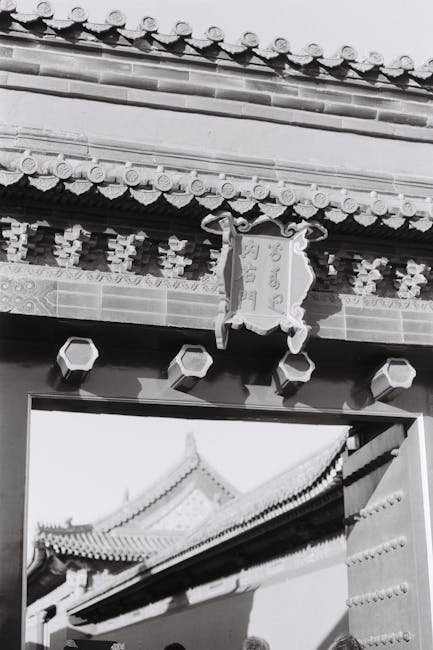
Screen walls come in several types, distinguished by their position relative to the entrance. An "outside screen wall" (外影壁) is placed on the street side of the gate, visible to passersby. An "inside screen wall" (内影壁) is placed just inside the gate, facing the visitor as they enter. The most elaborate screen walls are found in the courtyard houses of wealthy families, where they are constructed of brick or stone and covered with decorative carvings or glazed tiles.
The decoration of screen walls follows established conventions. The central panel typically features a large character for good fortune (福, fu) or longevity (寿, shou), or a carved scene with auspicious symbolism — cranes and pine for longevity, mandarin ducks for marital fidelity, bats for good fortune (the word for bat, 蝠, is a homophone for good fortune, 福). The top of the wall is often capped with a miniature roof, complete with tiles and ridge ornaments, making the screen wall a building in miniature. In imperial architecture, screen walls are sometimes surfaced with yellow or green glazed tiles, their decoration regulated by sumptuary laws.
The most famous screen wall in China is the Nine-Dragon Wall (九龙壁) in Beijing's Forbidden City and Beihai Park. These monumental glazed-tile screen walls, built during the Ming and Qing dynasties, depict nine intertwined dragons in high relief against backgrounds of clouds and waves. Each dragon is rendered in a different color, and the composition is designed so that the central dragon — the largest and most elaborately detailed — represents the emperor himself. Similar Nine-Dragon Walls exist in Datong, Shanxi province, where a wall from the Ming dynasty's Prince of Dai's palace survives as one of the oldest and finest examples. These walls demonstrate how the humble screen wall, originally a simple device for privacy and spirit protection, could be elevated to the status of a major architectural monument when commissioned by imperial or princely patrons.
Beyond the famous imperial examples, screen walls in vernacular architecture displayed remarkable regional diversity. In Shanxi province, the screen walls of merchant mansions in Pingyao and Qixian were carved with scenes from Chinese opera, historical narratives, and daily life — reflecting the values and aspirations of the merchant class that dominated the region. In Fujian, screen walls were often built of local stone rather than brick, their carvings featuring the distinctive marine motifs of the coastal region. In the Jiangnan region around Suzhou, screen walls were more refined and understated, often left whitewashed and unadorned except for a single carved panel at the center. This regional variation of a single architectural element reveals how Chinese architecture maintained a common vocabulary while allowing for local expression and adaptation.
Contemporary Relevance
While modern Chinese architecture has largely abandoned the formal screen wall, the principles it embodies remain relevant. Contemporary architects often use freestanding walls, water features, or plantings at building entrances to create privacy, manage views, and provide a transition between public and private space. The screen wall's function of controlling the visual sequence — revealing space gradually rather than all at once — is employed in museums, hotels, and cultural centers that seek to create a sense of journey and discovery.
For homeowners interested in Chinese design, a reinterpreted screen wall can be an effective way to add privacy and architectural interest to a modern home. A well-designed screen wall at the entrance creates a moment of pause, defines the threshold between outside and inside, and provides an opportunity for decorative expression. Whether executed in traditional brick and tile or in contemporary materials such as metal, glass, or stone, the screen wall principle remains a valuable tool in the architect's repertoire.
The most celebrated screen walls in China are the three surviving Nine-Dragon Walls (九龙壁, jiu long bi) from the Ming and Qing dynasties. The finest stands in Beijing's Beihai Park, built in 1756 during the Qianlong reign. Measuring over 25 meters long and nearly 7 meters high, it features nine coiling dragons in high-relief glazed ceramic tiles of deep blue, green, gold, and purple — each dragon playing with a flaming pearl amid swirling clouds and waves. The wall contains 424 individual glazed ceramic tiles, each custom-made to fit its specific position within the overall mosaic composition, representing an extraordinary coordination of architectural design and ceramic craftsmanship. The other two Nine-Dragon Walls are found in the Forbidden City and in Datong, Shanxi province, where a Ming dynasty example from the Prince of Dai's palace survives as one of the oldest and finest specimens.
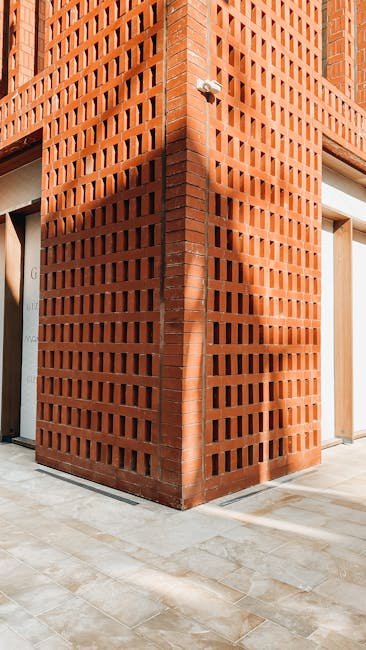
In contemporary architecture, the screen wall concept has been reinterpreted through modern materials and spatial strategies. Japanese architect Kengo Kuma has employed wooden lattice screens that reinterpret the traditional Chinese screen wall through the lens of Japanese craftsmanship. Chinese architect Wang Shu has used recycled brick screens to mediate between historic contexts and new interventions. These examples demonstrate that the screen wall principle — creating layered thresholds that control visibility, light, and movement — remains a fertile source of architectural ideas that transcends its specific historical and cultural origins
The construction techniques employed in traditional Chinese screen walls reveal sophisticated craftsmanship that balances structural durability with decorative refinement. The typical screen wall is built on a stone plinth that elevates it above ground moisture, with the main body constructed of brick or rammed earth faced with decorative plaster, tile, or carved panels. The plinth is often carved in shallow relief with patterns of overlapping lotus petals or cloud bands, while the wall body may be divided into three vertical sections: a central panel containing the main decoration, flanked by narrower side panels supporting inscriptions or secondary carvings. The wall is capped with a miniature roof structure featuring projecting rafters, ceramic roof tiles, and ridge ornaments that mirror full-scale roof construction in reduced dimensions. At the base of the wall, drainage channels are incorporated into the design to prevent water from pooling at the foundation, a practical detail that reflects the Chinese builder's characteristic attention to the relationship between architecture and the natural elements. In the finest examples, the screen wall becomes a complete architectural composition in miniature, with its own proportional system, structural logic, and decorative hierarchy — a building reduced to its essential elements and compressed into a single architectural plane.
Beyond their presence in traditional Chinese architecture, screen walls have been adopted and adapted in architectural traditions throughout East Asia. In Japan, the engawa veranda and the genkan entryway with its shoe-removal step serve a similar threshold function, marking the transition between the public street and the private interior. Korean traditional houses (hanok) feature similar entrance screens, often decorated with painted folk motifs that serve both protective and decorative functions. In Southeast Asian Chinese diaspora communities, from Singapore to San Francisco, the screen wall appears in the architecture of Chinese temples, clan associations, and shophouses, maintaining its traditional functions of spirit protection, privacy control, and status display. The migration of the screen wall across national and cultural boundaries testifies to the universality of its core functional insight: that the threshold between public and private space is not merely a physical transition but a psychological and social one, and that architecture has the capacity — and the responsibility — to shape this transition in ways that enhance human experience of space.
Screen Wall Construction
The construction of a traditional Chinese screen wall follows established architectural principles. The wall is built on a stone plinth that elevates it above ground moisture, with the main body constructed of brick or rammed earth faced with decorative plaster, tile, or carved panels. The plinth is often carved with patterns of overlapping lotus petals or cloud bands. The top of the wall is capped with a miniature roof structure featuring projecting rafters, ceramic roof tiles, and ridge ornaments that mirror full-scale roof construction. This architectural composition in miniature gives the screen wall the presence of a complete building compressed into a single plane.
The structural stability of a freestanding screen wall requires careful engineering. The wall's thickness must be proportional to its height to resist wind loads, and the foundation must extend below the frost line to prevent uneven settlement. In northern China, where earthquakes are a concern, screen walls were sometimes built with a slight backward lean that would counteract the forward thrust of seismic shaking. Drainage channels at the base of the wall prevented water from pooling at the foundation, while the overhanging miniature roof protected the wall surface from rain damage. These practical considerations, combined with the wall's symbolic and decorative functions, made the screen wall a remarkably complete architectural element that integrated structure, symbolism, and craft.
Regional Variations of Screen Walls
Screen walls across China display remarkable regional diversity reflecting local materials, climate, and cultural traditions. In the Shanxi region, screen walls of merchant mansions in Pingyao were carved with scenes from Chinese opera and historical narratives, reflecting merchant class values. In Fujian, screen walls were built from local stone with marine motifs. In Jiangnan around Suzhou, screen walls were more refined and understated, often left whitewashed except for a single carved panel. This regional variation shows how Chinese architecture maintained a common vocabulary while allowing local expression.
In Beijing, the screen walls of siheyuan courtyard houses were typically faced with grey bricks and decorated with a central panel bearing the character for good fortune (福, fu) or longevity (寿, shou). Imperial screen walls in the Forbidden City were surfaced with yellow or green glazed tiles, their decoration regulated by sumptuary laws. In the southern provinces of Guangdong and Fujian, screen walls were often built of brick with ceramic tile insets, their colors and patterns reflecting the region's vibrant decorative traditions. The diversity of screen wall traditions across China provides a microcosm of the country's broader architectural diversity, demonstrating how a single architectural element could be adapted to suit different regional conditions while maintaining its essential function and identity.
Screen Walls Beyond China
The screen wall concept has been adopted and adapted in architectural traditions throughout East Asia. In Japan, the genkan entryway with its shoe-removal step serves a similar threshold function. Korean traditional houses feature similar entrance screens decorated with painted folk motifs. In Southeast Asian Chinese diaspora communities from Singapore to San Francisco, the screen wall maintains its traditional functions of spirit protection and privacy control. This migration across national boundaries testifies to the universality of the screen wall's core insight: that the threshold between public and private space is both a physical and psychological transition.
In contemporary architecture, the screen wall principle has been reinterpreted through modern materials and spatial strategies. Japanese architect Kengo Kuma has employed wooden lattice screens that reinterpret the traditional screen wall through Japanese craftsmanship. Chinese architect Wang Shu has used recycled brick screens to mediate between historic contexts and new interventions. These examples demonstrate that the screen wall principle remains a fertile source of architectural ideas, creating layered thresholds that control visibility, light, and movement in ways that transcend its specific historical and cultural origins.