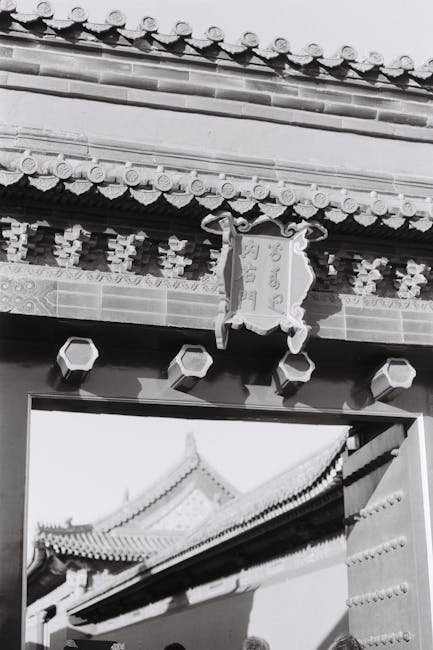
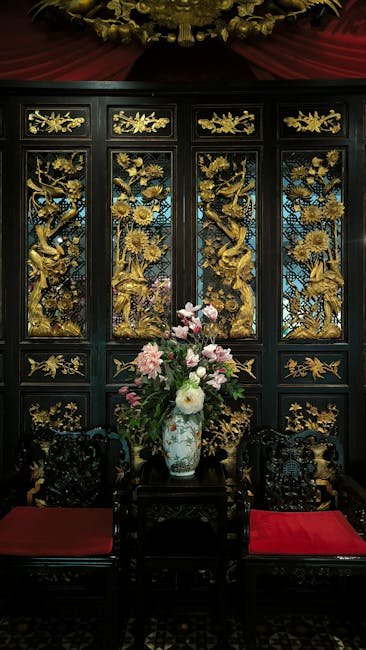
The three carving arts (三雕, san diao) — wood carving (木雕), brick carving (砖雕), and stone carving (石雕) — are the primary decorative arts of traditional Chinese architecture. These crafts transform structural and functional elements into works of sculpture, adorning buildings with intricate patterns, figures, and scenes that convey cultural values, social status, and aesthetic refinement. The three carving arts are found throughout China, with each region developing its own distinctive styles and specialties.
Wood Carving (木雕)
Wood carving is the most visible and widely practiced of the three carving arts. In traditional Chinese architecture, wood carving is found on beams, brackets, door panels, window lattices, screens, and furniture. The carving techniques include relief carving (浮雕, fu diao), in which the design projects from the background; openwork carving (透雕, tou diao), in which the background is cut away entirely; and three-dimensional carving (圆雕, yuan diao), in which the carving is fully dimensional and viewable from all sides.
The subject matter of Chinese wood carving draws from a rich repertoire of symbols and stories. Auspicious motifs include dragons, phoenixes, lions, and qilin (mythical hooved creatures). Natural motifs include the "Four Gentlemen" — plum blossom, orchid, bamboo, and chrysanthemum — representing the four seasons and the virtues of the scholar-gentleman. Narrative scenes from Chinese opera, classical literature, and historical events are carved on panels and screens, turning the building into a visual encyclopedia of Chinese culture.
"Chinese architectural carving is not merely decorative — it is a language. Every motif carries meaning, every pattern tells a story, and every composition reflects the values of the household. A carved beam is a book to be read, and the carver is a scribe rendering Confucian virtues, Daoist harmony, and Buddhist compassion in wood and stone."
Brick Carving (砖雕)
Brick carving is a specialized craft that reached its highest development in the Huizhou region of Anhui province and the Shanxi province. The technique involves carving designs into specially prepared bricks — typically made from fine-grained clay that is fired to a precise hardness that allows carving without crumbling. Brick carvings are used on gateways, screen walls, wall panels, and roof ridges, where they provide durable decoration that withstands weather better than wood.
Huizhou brick carving is particularly renowned for its delicacy and detail. The carvers of Anhui developed a distinctive style characterized by multiple layers of relief, creating a sense of depth and perspective within the shallow plane of the brick surface. Typical subjects include garden scenes with figures, pavilions, and trees, rendered with extraordinary precision. The most elaborate brick carvings may contain dozens of figures in a single panel, each carefully carved and positioned to create a coherent scene.
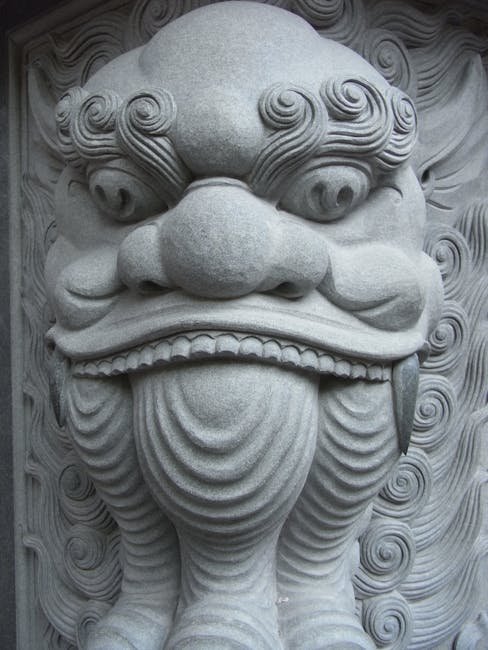
Stone carving (石雕) completes the triumvirate of Chinese architectural decorative arts. Stone is used primarily in outdoor locations: monumental gateways (牌坊, pai fang), column bases, balustrades, stair railings, and the drum stones (抱鼓石, bao gu shi) that flank important entrances. Unlike wood and brick, which are carved after fabrication, stone carving requires the sculptor to work with the inherent properties of the material — its grain, hardness, and fracture planes. The finest Chinese stone carving achieves an extraordinary vividness, with figures that seem to breathe beneath the chisel. The stone elephants along the Spirit Way of the Ming Tombs in Beijing, the carved balustrades of the Lugou Bridge, and the soaring stone brackets of Quanzhou's Kaiyuan Temple pagodas all testify to the supreme mastery of Chinese stone carvers over centuries of continuous practice.
Stone Carving (石雕)
Stone carving is the most durable of the three carving arts, used for structural elements that require strength and weather resistance. Stone carvings are found on column bases, balustrades, stairways, bridges, and memorial arches. The stone used varies by region — granite in Fujian, limestone in Anhui, sandstone in Sichuan — with each stone type requiring different carving techniques and producing different aesthetic effects.
The most celebrated stone carving tradition is found in Fujian, particularly in the Hui'an county, which has been a center of stone carving for over a thousand years. Hui'an stone carvers are famous for their ability to render soft, flowing forms in hard granite — dragons coiling around columns, lions guarding entrances, and lotus petals adorning column bases. The stone carving tradition continues today, with Hui'an carvers producing work for buildings throughout China and around the world. The survival of these ancient crafts into the modern era testifies to the enduring value of traditional Chinese architectural decoration.
Regional carving styles developed distinct characteristics that reflected local materials, patronage patterns, and aesthetic preferences. Zhejiang's Dongyang wood carving tradition — recognized as a National Intangible Cultural Heritage since 2006 — is celebrated for its high-relief narrative panels depicting classical stories with dozens of figures in complex spatial compositions. Anhui's brick carvers, working for the wealthy Huizhou merchants, developed an extraordinarily refined technique capable of rendering the finest details in fired clay — facial expressions, textile patterns, and individual leaves on trees. Shanxi's stone carvers, supplied by the province's abundant quarries, produced the monumental gateway arches and screen walls that announce the prosperity of Shanxi's historic banking families.
The transmission of carving skills has traditionally followed a master-apprentice system, with young apprentices entering workshops at age twelve or thirteen and spending a decade mastering the craft before being permitted to work on major commissions independently. In recent decades, this system has come under pressure from the declining demand for hand-carved architectural ornament in new construction. However, government recognition of intangible cultural heritage status and the growing market for historic building restoration have created new opportunities. Several carving academies in Dongyang, Huizhou, and Hui'an now offer formal training programs that combine traditional apprenticeship methods with modern design education, ensuring that the skills accumulated over centuries of Chinese architectural practice will survive into the next generation, carrying forward a tradition of craftsmanship that has enriched the built environment of China for over two thousand years.
The future of Chinese architectural carving depends on maintaining the delicate balance between preservation and innovation. While museum-quality restoration work will always demand traditional hand-carving techniques, new markets are emerging for carved architectural elements produced with computer-aided design and CNC routing. Several workshops in Dongyang and Huizhou now combine digital scanning of historic carvings with robotic fabrication of new pieces, achieving levels of precision and productivity unimaginable to previous generations. These hybrid approaches, far from threatening the tradition, may ensure its survival by making hand-quality carved ornamentation accessible for contemporary building projects that could never afford fully hand-carved decoration.
The conservation of historic carved architectural elements presents distinct challenges. Wood carvings on exposed beams and brackets suffer from centuries of dust accumulation, insect infestation, and moisture damage that can erode fine details beyond recognition. Conservation workshops in Dongyang have developed specialized techniques for cleaning and consolidating ancient wood carvings, including the use of enzyme-based cleaners that remove grime without damaging the original surface, and controlled-atmosphere chambers for eradicating wood-boring insects without toxic chemicals. Brick carvings, being more porous than wood, are vulnerable to surface spalling caused by freeze-thaw cycles, salt crystallization, and air pollution. Conservators at Huizhou heritage sites have pioneered the use of compatible repair mortars and sacrificial protective coatings that slow deterioration without altering the historic fabric. Stone carvings, while the most durable, suffer from biological colonization by lichens and moss, and from the structural stresses imposed by earthquakes and uneven foundation settlement. The ongoing conservation of carved architectural elements at major heritage sites employs teams of specialized conservators, craftspeople, and materials scientists working together to extend the lifespan of these irreplaceable works of art.
The market for traditional Chinese architectural carving has experienced a significant revival since the early 2000s, driven by three converging factors: the explosion of heritage tourism, the restoration of historic buildings across China, and the demand for carved ornamentation in new buildings designed in traditional styles. Major restoration projects at sites such as the Confucius Temple in Qufu, the Nanchan Temple in Shanxi, and the historic merchant mansions of Huizhou have provided continuous employment for thousands of carvers. At the same time, a new generation of Chinese architects designing cultural buildings — museums, visitor centers, and tea houses — have commissioned carved architectural elements as a way of connecting contemporary design to China's craft heritage. The most successful of these projects demonstrate that traditional carving, far from being a nostalgic relic, remains a living art form capable of enriching the built environment of the twenty-first century.
The aesthetic appreciation of Chinese architectural carving requires an understanding of its subject matter that goes beyond mere visual pleasure. The carver's repertoire draws from a vast treasury of Chinese visual culture — the dragons and phoenixes of imperial iconography, the flowers and birds of scholarly painting, the figures and scenes of folk opera — each motif carrying specific meanings that would have been immediately legible to the traditional Chinese viewer. A beam carved with bats and peaches conveys a wish for blessings and longevity; a screen panel showing boys at play beneath a pomegranate tree expresses hope for many male descendants; a column base carved with lotus petals draws on Buddhist symbolism of purity emerging from muddy waters. The modern viewer who takes the time to learn this symbolic language discovers that a carved building is not merely decorated but narrated — every surface telling stories, expressing wishes, and encoding the values that shaped one of the world's great architectural traditions.
Techniques and Tools of Chinese Carving
Chinese architectural carvers employ a specialized toolkit that has evolved over centuries. The primary tools include various chisels (凿, zao) for rough shaping and detail work, gouges (圆刀, yuan dao) for curved surfaces and concave details, and knives (刻刀, ke dao) for fine line work and undercutting. Wood carvers use mallets (锤, chui) made of hardwood or rubber to strike the chisels, while brick and stone carvers use hammers of different weights. The selection of tools depends on the material being carved, the depth of relief required, and the fineness of detail desired.
The carving process follows a methodical sequence that progresses from rough to fine. The carver first sketches the design on the material surface, either freehand or using paper patterns. Rough carving removes the background material around the design, establishing the basic depth of the relief. Intermediate carving refines the shapes and begins to define details within the design. Fine carving completes the details — facial features, textile patterns, leaves, and other small elements. The final stage involves smoothing the background surface and applying a protective finish. For wood carvings, this finish is typically tung oil or lacquer that protects against moisture and insect damage while enhancing the natural grain of the wood.
Symbolism in Carving Motifs
The motifs used in Chinese architectural carving form a comprehensive visual language. Auspicious animals convey specific blessings: the dragon represents imperial power and cosmic force; the phoenix symbolizes beauty and renewal; the qilin, a mythical hooved creature, signifies benevolence and prosperity. The Four Gentlemen of Chinese painting — plum blossom, orchid, bamboo, and chrysanthemum — represent the four seasons and the virtues of the ideal scholar-gentleman. Narrative scenes from Chinese opera, classical literature, and historical events are carved on panels and screens, turning the building into a visual encyclopedia of Chinese culture.
The placement of carved motifs on a building followed established hierarchies. The most prominent locations — the central beam of the main hall, the primary entrance gate, the principal screen wall — received the most elaborate carvings, often featuring dragons or narrative scenes. Secondary locations featured less complex motifs, while utilitarian areas received minimal or no carving. This hierarchical distribution of decoration reinforced the building's spatial hierarchy, guiding the visitor's eye to the most important areas and communicating the relative significance of different spaces through the richness of their carved ornamentation.
The Future of Carving Arts
The transmission of carving skills has traditionally followed a master-apprentice system, with apprentices entering workshops at a young age and spending a decade mastering the craft. In recent decades, this system has faced pressure from declining demand for hand-carved ornament in new construction. However, government recognition of intangible cultural heritage status and the growing market for historic building restoration have created new opportunities. Several carving academies in Dongyang, Huizhou, and Hui'an now offer formal training combining traditional methods with modern design education.
New technologies are transforming the carving trade. Computer-aided design and CNC routing allow workshops to produce carved elements with precision and efficiency unimaginable to previous generations. Digital scanning of historic carvings creates archives that preserve the exact geometry of irreplaceable works. Some workshops now combine digital fabrication with hand finishing, achieving a balance between productivity and craftsmanship. These hybrid approaches may ensure the survival of carving traditions by making ornamentation accessible for contemporary projects that could never afford fully hand-carved decoration, while preserving the skills needed for museum-quality restoration work on historic buildings.