The Chinese garden is one of the world's great artistic traditions, a three-dimensional art form that combines architecture, landscape design, painting, poetry, and philosophy into a unified whole. Unlike Western gardens, which often emphasize formal symmetry and control over nature, Chinese gardens seek to create a miniature version of the natural landscape, evoking the wild beauty of mountains, rivers, and forests in a confined urban space. The garden is not merely a place of beauty but a setting for contemplation, artistic creation, and social interaction.
Philosophical Foundations
Chinese garden design is grounded in Daoist and Confucian philosophy. The Daoist concept of "naturalness" (自然, ziran) encourages designs that appear effortless and unforced, as if the garden grew organically rather than being artificially constructed. The principle of "borrowed scenery" (借景, jie jing) brings distant mountains, pagodas, or trees into the garden's visual field, dissolving the boundary between the garden and the wider landscape. The Confucian emphasis on cultivation and refinement is expressed in the garden's literary associations — pavilions and rocks are inscribed with poems, and plantings evoke classical allusions.
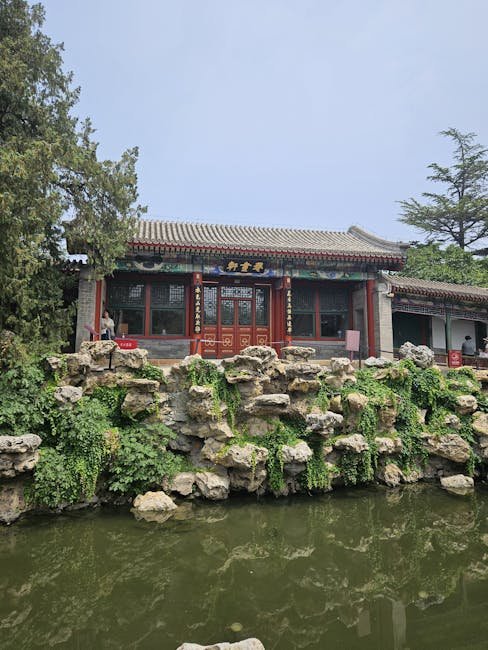
The four essential elements of the Chinese garden are rocks, water, plants, and architecture. Rocks — particularly the fantastically weathered Taihu limestone (太湖石) from Lake Tai — are the "bones" of the garden, creating vertical accents and sculptural forms. Water is the "blood," providing reflection, movement, and sound. Plants — bamboo, pine, plum, orchid, and lotus — are chosen for their symbolic meanings as well as their visual qualities. Architecture — pavilions, corridors, bridges, and pavilions — frames views and provides spaces for contemplation.
The selection and placement of Taihu rocks (太湖石, Taihu shi) is an art form in itself. These limestone rocks, quarried from the waters of Lake Tai near Suzhou, have been sculpted by centuries of erosion into fantastical shapes — perforated, twisted, hollowed, and weathered into forms that suggest distant mountains, mythical beasts, or abstract sculptures. Garden connoisseurs of the Ming dynasty developed a sophisticated taxonomy of rock aesthetics, articulated by the scholar Mi Fu (米芾) in his "Four Qualities" of fine garden rocks: shou (瘦, leanness), tou (透, perforation), lou (漏, hollowness), and zhou (皱, wrinkling). A rock that exhibited all four qualities in balanced proportion was considered a masterpiece worth more than its weight in gold. The largest and finest Taihu rocks — some standing over five meters tall — graced the gardens of emperors and the wealthiest officials, and several survive today in the gardens of Suzhou as silent witnesses to a lost world of connoisseurship.
"A Chinese garden is a landscape painting made three-dimensional. Every rock is a mountain in miniature, every pool an ocean, every tree a forest. The garden designer creates not a copy of nature but an essence of nature, distilled and concentrated within a walled enclosure. To walk through a Chinese garden is to walk through a poem."
Garden Design Principles
Chinese garden designers employ a sophisticated set of design principles to create the experience of natural landscape within a confined space. "Contrast and complement" (对比与衬托) uses juxtapositions of light and shadow, rough and smooth, open and enclosed to create visual interest. "Winding and indirection" (曲折与含蓄) ensures that views unfold gradually, with pavilions and plants placed to conceal as well as reveal, creating a sense of depth and mystery. The path through a Chinese garden is never straight — it curves and doubles back, delaying arrival and prolonging the visitor's engagement with the landscape.
The "Four Seasons" principle ensures that the garden offers interest throughout the year. Spring brings plum blossoms and peach flowers, summer offers lotus blooms on the pond, autumn delights with chrysanthemums and maple leaves, and winter reveals the austere beauty of bamboo and pine against bare rock and snow. Evergreen plants provide structure year-round, while deciduous trees and seasonal flowers create a constantly changing tapestry of color and form. A well-designed Chinese garden is never the same from one visit to the next.
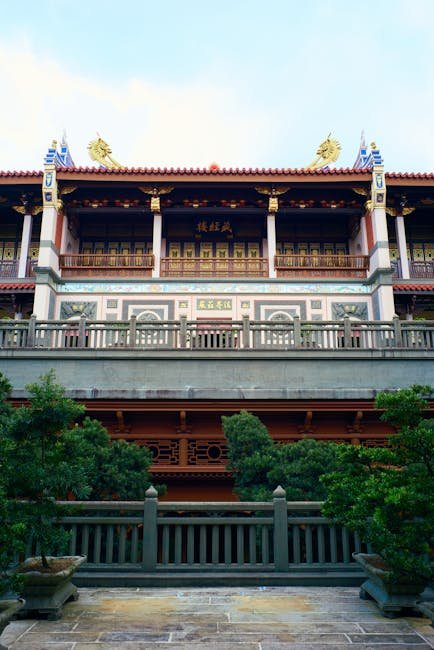
The relationship between architecture and landscape in the Chinese garden is fundamentally different from the Western tradition. In a Chinese garden, the buildings do not dominate the landscape but are woven into it. A pavilion is positioned not to command a view but to complete a composition — it may be partially hidden behind a rockery, revealed only at a specific turn of the path. Windows in garden walls are shaped like fans, moons, or gourds, each framing a carefully selected view of a rock, a branch of plum blossom, or a distant pagoda. This technique — known as "borrowed scenery" (借景) — extends the garden's perceived boundaries far beyond its walls, dissolving the distinction between the designed and the natural, between inside and outside. The covered corridor (廊, lang) exemplifies this philosophy: it is simultaneously a walkway, a viewing platform, and a framing device, its lattice windows creating patterns of light and shadow that shift with the movement of the sun. The result is an architecture that serves the landscape rather than imposing upon it, creating a garden that feels timeless, boundless, and deeply at peace.
The experience of a Chinese garden is deliberately layered and nonlinear. Paths are designed to meander, forcing the visitor to slow down and observe. A single pavilion may be approached from several different directions, each approach revealing a different aspect of its relationship to the surrounding landscape. The placement of garden elements is calibrated to create a sequence of distinct moods — from open and bright near the entrance to increasingly intimate and contemplative as one moves deeper into the garden. This psychological journey through space, alternating between compression and release, concealment and revelation, is perhaps the most sophisticated achievement of Chinese garden design. It transforms a walk through a garden from a simple physical movement into a meditative experience that engages the mind as deeply as the senses.
Famous Gardens
China's most celebrated gardens are concentrated in Suzhou, where the Humble Administrator's Garden, the Lingering Garden, the Master-of-Nets Garden, and the Mountain Villa with Embracing Beauty represent the pinnacle of the art. These gardens were built by retired officials and scholars during the Ming and Qing dynasties, using their wealth to create private paradises that expressed their cultural refinement and provided settings for literary and artistic pursuits. Each garden has its own character — the Humble Administrator's Garden is expansive and watery, the Master-of-Nets Garden is intimate and refined, the Lingering Garden is famous for its extraordinary Taihu rockeries.
Beyond Suzhou, notable gardens include the Summer Palace in Beijing, which combines imperial grandeur with garden artistry on a vast scale; the Garden of the Unsuccessful Politician in Shanghai; and the Ge Garden in Yangzhou, renowned for its four-season rockery made from four different types of stone. All of these gardens share the fundamental principles of Chinese garden design while expressing the individual vision of their creators and the characteristics of their regions. Together, they constitute an artistic heritage of world significance.
The design philosophy of Chinese gardens has had a profound influence on landscape architecture worldwide. The 18th-century English landscape garden movement, led by designers such as William Kent and Lancelot Capability Brown, drew inspiration from Chinese garden principles that had been described by European travelers and missionaries. The informality of the English landscape garden — its winding paths, irregular lakes, and carefully composed views — represented a deliberate rejection of the formal French garden style in favor of what was perceived as a more natural, Chinese-inspired approach. In the 20th century, the Japanese American sculptor Isamu Noguchi incorporated Chinese garden principles of rock placement and spatial composition into his celebrated garden designs for the UNESCO headquarters in Paris and the Billy Rose Sculpture Garden in Jerusalem. The influence has also flowed in the reverse direction: contemporary Chinese landscape architects, educated in both Eastern and Western traditions, are creating new garden works that synthesize the spatial principles of the classical Suzhou garden with the programmatic demands of modern urban parks, demonstrating that the Chinese garden tradition is not a museum relic but a living design language.
The contemporary relevance of Chinese garden design extends beyond aesthetics to environmental performance. The classical Chinese garden, with its water features, tree canopy, and porous paving, functions as a microclimate modifier — reducing ambient temperatures, managing stormwater, and supporting urban biodiversity. Contemporary architects and landscape designers in China's rapidly urbanizing cities have begun to reapply these principles on a larger scale, incorporating traditional garden concepts of water management, borrowed scenery, and layered vegetation into the design of urban green spaces. The landscape architect Kongjian Yu, founder of Turenscape and a leading voice in the Sponge City movement, explicitly draws on traditional Chinese garden and agricultural water management techniques in his designs for urban wetlands and flood-control parks across China. Yu's work demonstrates that the philosophical and technical wisdom embedded in the Chinese garden tradition — a tradition that began with scholars building private retreats in Suzhou over a thousand years ago — can offer practical solutions to the environmental challenges facing twenty-first-century cities worldwide.
Courtyard Design and Composition
The traditional Chinese courtyard (院子, yuanzi) is a fundamental architectural unit that organizes domestic life around an open central space. Unlike the Western courtyard, which is often a decorative garden feature, the Chinese courtyard is the functional and spiritual heart of the home. In northern China, the siheyuan (四合院) courtyard house type arranges buildings around a rectangular courtyard, with the main hall facing south and side wings to the east and west. The courtyard itself serves as an outdoor living room — a space for dining, socializing, children's play, and household chores — while providing light, ventilation, and drainage to the surrounding rooms.
The spatial composition of a Chinese courtyard follows strict hierarchical principles. The main building at the north end of the courtyard is the most important, occupied by the head of the household or used for ancestral worship. The east and west wings house junior family members according to seniority, while the south-facing building nearest the entrance serves as a reception hall or guest quarters. The courtyard's proportions are carefully calibrated: too wide and the space feels exposed, too narrow and it becomes a lightwell rather than a living space. The ideal courtyard achieves a harmonious ratio of building height to courtyard width, typically between 1:1 and 1:1.5, creating an enclosed space that feels both protected and open to the sky. The ground surface is traditionally paved with brick or stone in a pattern that directs rainwater toward a central drain, while trees and plants are placed to provide shade in summer without blocking winter sunlight from the main hall.
Rockery and Water Features
The construction of artificial rockeries (假山, jiashan) is one of the most demanding arts in Chinese garden design. Master rockery artisans, known as dieshan jiang (叠山匠, "mountain-piling craftsmen"), spend decades learning to select, transport, and assemble large limestone rocks into compositions that evoke natural mountain landscapes. The rocks are not mortared together but are carefully balanced and interlocked, relying on gravity and precise fitting for stability. A well-constructed rockery should appear as if it has been there since before the garden was built, with moss and lichen encouraged to grow on its surfaces to enhance the sense of age.
Water features in Chinese gardens range from small ponds and streams to extensive lakes. The water's edge is never straight but curves naturally, with rocks and plants softening the transition between water and land. Bridges — arched stone bridges, zigzag wooden bridges, or simple stepping stones — cross the water at carefully chosen points, creating viewing platforms and symbolic passages. The sound of water is deliberately incorporated into the garden experience: waterfalls are positioned near pavilions so that guests can hear the gentle splash while drinking tea or composing poetry. Koi carp, lotus flowers, and water lilies add life and color to the water surface, completing the microcosm of nature that the Chinese garden seeks to create.
Symbolism in Garden Plants
Every plant in a Chinese garden carries symbolic meaning, and their placement is as carefully considered as the arrangement of rocks and architecture. Pine trees (松, song) represent longevity and endurance, their evergreen needles remaining green through winter snow. Bamboo (竹, zhu) symbolizes resilience and moral integrity — it bends in the wind but does not break, a Confucian metaphor for the virtuous person who adapts to circumstances without compromising principles. Plum blossoms (梅, mei), which bloom in late winter before the snow has melted, represent perseverance and hope, while peonies (牡丹, mudan) symbolize wealth and honor.
The seasonal sequence of blooms is orchestrated to ensure continuous visual interest. Early spring brings plum and peach blossoms, followed by magnolias and camellias. Late spring and summer feature peonies, lotuses, and jasmine. Autumn is celebrated with chrysanthemums, osmanthus fragrance, and the reddening leaves of maple trees. Winter reveals the stark beauty of bare branches, evergreen pines, and the sculptural forms of Taihu rocks against snow. This carefully choreographed cycle of bloom and dormancy reflects the Daoist appreciation of impermanence and the beauty of each season, making the Chinese garden a place of perpetual discovery and contemplation throughout the year.

Dougong
The interlocking timber bracket system
Feng Shui Basics
Harmonizing buildings with nature
Roof Types
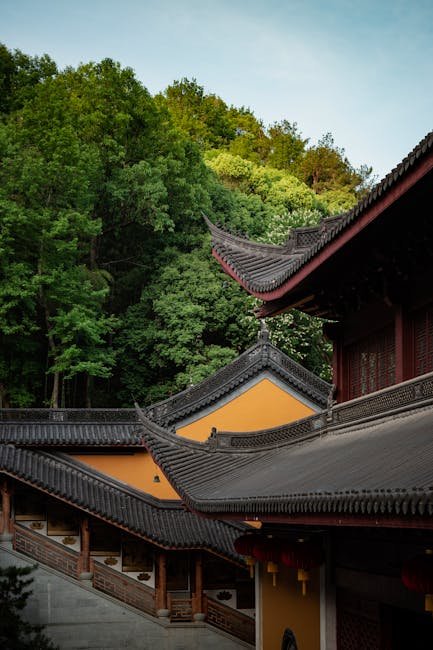
The hierarchy of Chinese roof forms