Classical Chinese Interiors (古典中式)
Interior Style

Classical Chinese Interiors (古典中式)

The rich, refined aesthetic of traditional Chinese interiors, from rosewood furniture to decorative screens.

Classical Chinese interior design (古典中式, gu dian zhong shi) represents the traditional aesthetic of Chinese domestic interiors as it developed over centuries of imperial rule, reaching its mature form during the Ming (1368-1644) and Qing (1644-1912) dynasties. This style is characterized by the use of precious hardwoods, particularly rosewood (hongmu) and mahogany, elaborate carving and joinery, the deployment of screens and display cabinets as spatial organizers, and a rich vocabulary of decorative objects that convey the owner's status, education, and cultural refinement.

The Literati Aesthetic

The classical Chinese interior was shaped by the values of the scholar-official class (士大夫, shi da fu), who were the cultural arbiters of traditional China. The ideal interior according to the literati aesthetic was not ostentatiously wealthy but rather "elegant and refined" (雅致, ya zhi), expressing the owner's cultivation through the quality and selection of objects rather than their quantity or cost. A well-appointed study (书房, shu fang) was the heart of the literati home, containing a scholar's desk, bookshelves, a calligraphy table, and objects d'art such as brush pots, ink stones, and scholar's rocks that reflected the owner's taste.

The literati aesthetic valued the antique over the new, the subtle over the obvious, and the natural over the artificial. A Ming dynasty rosewood chair was prized for the quality of its wood and the precision of its joinery; a painting by a Song dynasty master was valued for the depth of its brushwork and the subtlety of its composition. This appreciation for quality and authenticity meant that classical Chinese interiors were often more restrained than Western conceptions of "Chinese style" might suggest, with carefully chosen objects displayed with generous space around them.

"A room should not be crowded with furniture and objects. Each piece should be chosen for its quality and meaning, and should be given space to be seen and appreciated. The classical Chinese interior is not a display of wealth but a reflection of the owner's mind — a mind that values quality over quantity, meaning over appearance, and beauty over decoration."
— Wen Zhenheng, Ming Dynasty Scholar, "Treatise on Superfluous Things"

Key Elements

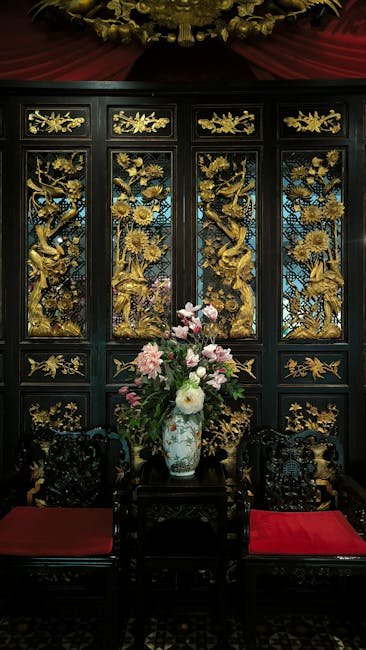
Several elements characterize the classical Chinese interior. The rosewood furniture (红木家具, hongmu jiaju) is the centerpiece, with pieces such as the armchair (太师椅, taishi yi), the yoke-back chair (官帽椅, guanmao yi), and the rectangular table (条案, tiao an) displaying the exquisite craftsmanship of Chinese furniture makers. The folding screen (屏风, ping feng) serves as a movable architectural element, dividing space, providing privacy, and creating a backdrop for the display of art and objects.

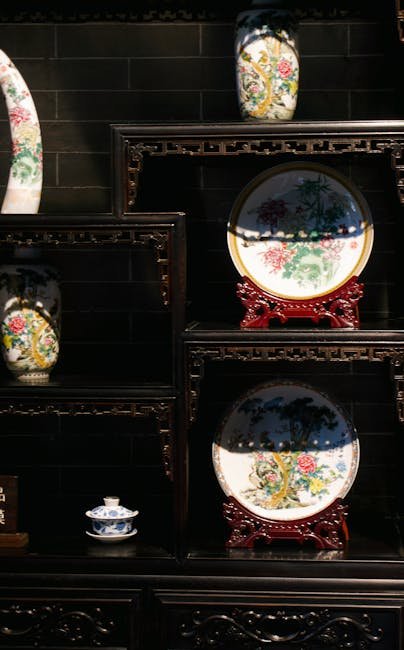
Display cabinets (多宝格, duo bao ge) are distinctive Chinese furniture pieces designed for the exhibition of small treasures — porcelains, jades, bronzes, and curios. These cabinets feature numerous compartments of varying sizes and shapes, creating a visually interesting display surface while protecting the objects within. The "treasure cabinet" is a microcosm of the collector's mind, with each compartment holding a carefully chosen object that rewards close inspection.

Materials and Color

The classical Chinese interior is dominated by the warm, rich colors of precious hardwoods — rosewood ranges from deep purple-brown to reddish-brown, while nanmu (楠木) has a golden-yellow hue. These woods are finished with clear lacquer that protects the surface while allowing the natural grain to show through. The walls are typically white or off-white, providing a neutral backdrop for the furniture and artworks. Flooring may be of wood, stone, or ceramic tile, often partially covered with silk or wool rugs.

Accent colors are drawn from the traditional Chinese palette: the deep red of lacquerware, the blue of Qing dynasty porcelain, the green of celadon, and the gold of gilt bronzes. These colors appear in decorative objects, textile accents, and sometimes in painted architectural elements such as beam decorations. The overall effect is an interior that feels warm, luxurious, and deeply connected to Chinese cultural tradition — a space that has been refined over centuries into an expression of beauty and meaning.

Related Articles