A hierarchical system of roof forms that express building function, status, and regional identity.
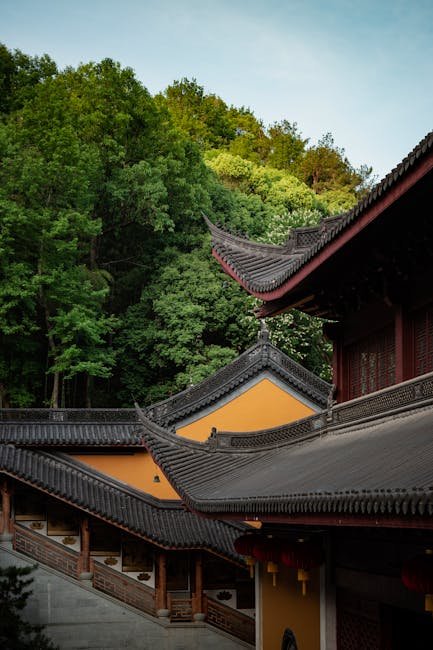
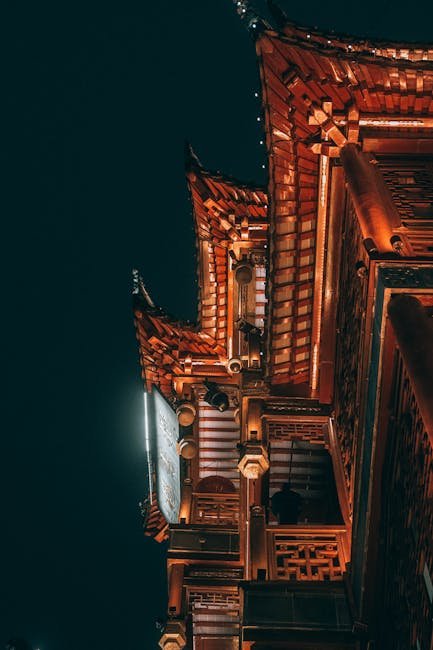
The roof is the most visually dominant element of any traditional Chinese building. Unlike Western architecture, where walls and columns often carry the primary visual weight, Chinese architecture emphasizes the roof — its form, its curves, its decoration, and its relationship to the building below. The Chinese roof is not merely a protective covering but a complex architectural statement that conveys the building's status, function, and cultural significance through its form, color, and ornamentation.
The Five Major Roof Forms
Chinese architectural tradition recognizes five major roof forms, arranged in a hierarchy from most to least prestigious. The hip roof (庑殿顶, wu dian ding) is the highest-ranking form, used exclusively for the most important buildings in the imperial palace and Confucian temples. It has four sloping surfaces that meet at a ridge, creating a majestic and stable silhouette. The hip-and-gable roof (歇山顶, xie shan ding) combines hip roof ends with gable sides and is used for secondary palace halls and important public buildings.
The overhanging gable roof (悬山顶, xuan shan ding) has gable ends that project beyond the wall plane, providing additional protection to the walls beneath. This form is common in southern China, where heavy rainfall makes extended eaves essential. The flush gable roof (硬山顶, ying shan ding) has gable ends that are flush with the wall plane, typical of northern Chinese vernacular buildings. The pavilion roof (攒尖顶, cuan jian ding) has a single point at the apex and is used for pavilions, pagodas, and corner towers, creating a light and elegant silhouette.
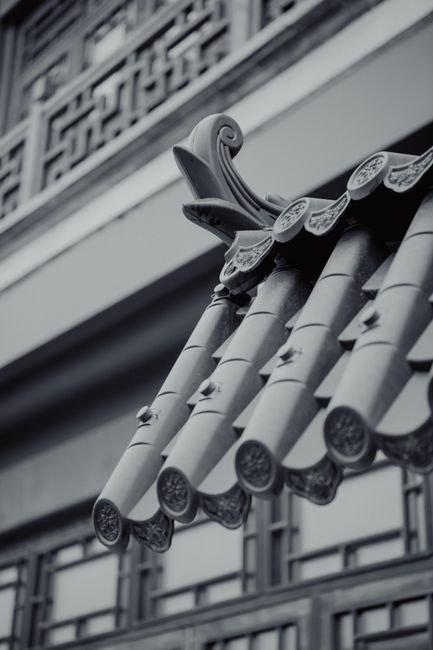
"The Chinese roof is not just a building element but a symbol. Its form announces the building's importance to all who approach. The curved eaves that rise at the corners are said to represent the wings of a bird in flight, lifting the building heavenward. Every ridge, every tile, every ornament carries meaning that has been understood by Chinese people for centuries."
Roof Decoration
Chinese roofs are richly decorated with elements that carry symbolic meaning. The ridge ornaments (脊兽, ji shou) are perhaps the most visible — a procession of mythical animals arranged along the roof ridges, with the number of figures indicating the building's status. The Forbidden City's Hall of Supreme Harmony has the maximum of eleven figures, including a dragon, phoenix, lion, horse, and various mythical creatures. The lead figure is always a "riding immortal" (骑凤仙人) followed by the animals in a fixed sequence.
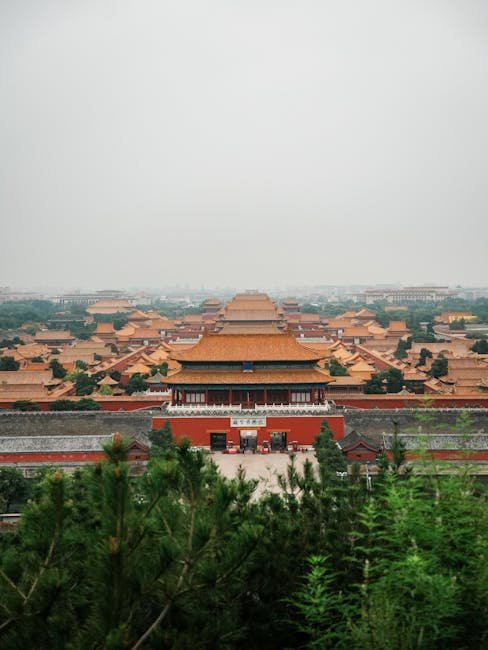
The color of roof tiles is also regulated by hierarchy. Yellow glazed tiles are reserved for imperial buildings, as yellow was the emperor's color. Green tiles are used for princely residences and important government buildings. Blue tiles symbolize heaven and are used on altars and temples. Black tiles, associated with water, are sometimes used in libraries and buildings that needed fire protection. Ordinary buildings use unglazed grey tiles, which are the most common roofing material across China.
Regional Variations
While the basic system of roof forms is standard across China, significant regional variations exist. Northern roofs tend to have shallower curves and more restrained decoration, reflecting the colder, drier climate and the conservative tastes of the imperial capital. Southern roofs, particularly in Jiangsu and Zhejiang, have more pronounced upward curves at the eaves, giving them a lighter, more graceful appearance that complements the region's garden architecture. In Fujian and Guangdong, roofs are often richly decorated with ceramic figures, a tradition that reaches its peak in the Minnan and Lingnan styles.
Understanding Chinese roof types is essential for anyone interested in Asian architecture. The roof is the dominant element of the Chinese building, and its form, color, and decoration carry more information about the building's status and meaning than any other single feature. From the sweeping yellow roofs of the Forbidden City to the simple grey-tiled roofs of a Sichuan farmhouse, the Chinese roof tradition encompasses an extraordinary range of forms that together constitute one of the world's great architectural achievements.